
Abbott (St. Jude Medical) Pacemaker & ICD EMI Survey
Engineering-Grade EMI Safety Surveys for Employees with Abbott Cardiac Devices
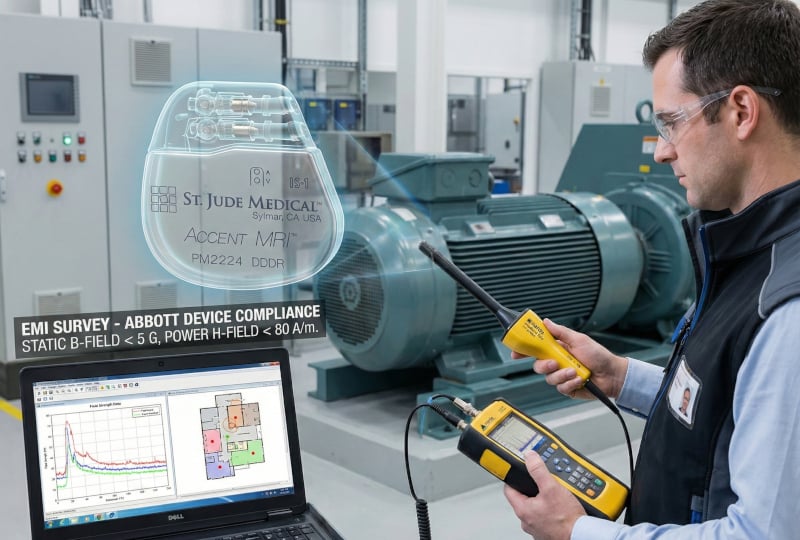
When an employee returns to work with an Abbott (formerly St. Jude Medical) implant, generic safety guidelines are often insufficient. Industrial environments contain complex electromagnetic fields (EMF) that may exceed the specific immunity shielding designed into these sophisticated devices.
At Castle Compliance, we perform manufacturer-specific electromagnetic interference (EMI) site surveys. We verify your facility against the exact technical thresholds defined in Abbott’s clinical engineering manuals, ensuring a safe and compliant return to work.
Abbott-Specific EMI Immunity Thresholds
Unlike general “EMF surveys,” our engineers test specifically against the pass/fail criteria for Abbott’s cardiac rhythm management devices. We utilize calibrated instrumentation to verify your equipment does not exceed the following Field Strength Test Limits:
| EMI Source Type | Field Type | Abbott Limit / Threshold |
| Static Magnetic Fields | B-Field (DC) | 5 Gauss (0.5 mT) |
| Industrial Power (50/60 Hz) | Magnetic (H-Field) | 80 A/m |
| Industrial Power (50/60 Hz) | Electric (E-Field) | 6,000 V/m |
Technical Note: These limits apply to Abbott’s rigorous international electromagnetic compatibility standards, including EN 45502-2-1 (Bradyarrhythmia) and EN 45502-2-2 (Tachyarrhythmia).
Why EMI Testing is Critical for Abbott Devices
If an employee unknowingly enters a zone exceeding these limits, their device may exhibit temporary but critical safety responses.
- Magnet Mode (Asynchronous Pacing) Exposure to Static Magnetic Fields above 5 Gauss (such as near DC motors or magnetic chucks) can trigger the device’s magnetic switch. This forces the pacemaker into a fixed rate (Asynchronous Pacing) regardless of the patient’s physiological needs.
- Inappropriate ICD Therapy For employees with Defibrillators (ICDs), strong electromagnetic noise can mimic a lethal heart rhythm. The device may attempt to deliver Anti-Tachycardia Pacing (ATP) or a high-voltage shock to “save” the patient from a phantom arrhythmia caused by a welder or motor.
- Inhibition of Pacing In high-noise environments, the device may “oversense” electrical interference, interpret it as a natural heartbeat, and pause necessary pacing therapy.
Our Abbott-Focused EMI Survey Process
Abbott Technical Services does not perform on-site field testing directly; they rely on third-party consultants to provide the raw environmental data. We fill that gap.
- Scope Definition: We evaluate specific work areas or the entire facility based on the employee’s role.
- In-Situ Measurement: We map the 80 A/m and 6,000 V/m zones in your facility, identifying exactly where “Safe” becomes “Restricted”.
- Data Interpretation: We can coordinate directly with Abbott Technical Services to help interpret our raw data relative to the patient’s specific device settings.
View Our Full EMI Risk Assessment Process & Capabilities
Ready to Schedule Your EMI Site Survey?
Ensure your employee returns to work safely and legally. Contact us for a Same-Day Quote on an Abbott-specific EMI Risk Assessment.
Explore Other Manufacturer-Specific EMI Surveys
Need a survey for a different device? We provide specialized engineering assessments for all major cardiac implant manufacturers. Select a manufacturer below to learn more about their specific safety protocols and our testing procedures.
General EMI Site Survey Services
- Overview of our comprehensive EMI testing process, safety standards, and compliance reporting for all implantable devices.
- Site surveys ensuring safe separation distances and return-to-work protocols for Medtronic devices.
- Detailed field mapping and risk assessment for Boston Scientific cardiac implants.
- Engineering surveys to verify compliance with Biotronik’s specific millitesla and frequency exposure limits.