
Boston Scientific Pacemaker, ICD & S-ICD EMI Survey
Engineering-Grade Safety EMI Surveys for Employees with Boston Scientific Devices
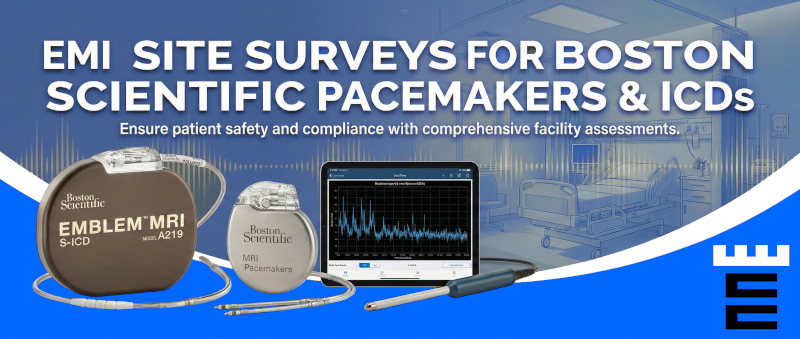
Boston Scientific designs its implantable devices (Pacemakers, ICDs, and S-ICDs) with robust shielding to ensure electromagnetic frequency (EMF) compatibility with daily life. However, industrial environments often produce electromagnetic energy levels that exceed the “suggested field exposure limits” found in the device’s technical manual.
At Castle Compliance, we perform the comprehensive worksite EMI surveys required to characterize these risks. We verify your facility against the distinct limits for Boston Scientific devices—which vary significantly based on the device type and even the side of the body where it is implanted.
Why “Generic” EMI Testing Fails for Boston Scientific
Unlike other manufacturers that often have a single pass/fail line, Boston Scientific provides granular exposure thresholds based on anatomical implant location.
Our engineers use calibrated instrumentation to test against the specific “measurement ceilings” for your employee’s device.
Power Frequency (50/60 Hz) & Static Field Limits
| Device & Location | Electric Field Limit (AC) | Static Magnetic Limit (DC) | Magnetic Field Limit (AC) |
| Pacemaker (Left Pectoral) | 6,500 V/m | 10 Gauss (1 mT) | 80 A/m (at 60 Hz) |
| Pacemaker (Right Pectoral) | 6,500 V/m | 10 Gauss (1 mT) | 110 A/m (at 60 Hz) |
| Defibrillator (CRT-D) | 11,700 V/m | 10 Gauss (1 mT) | 132 A/m (at 60 Hz) |
| S-ICD (Subcutaneous) | 6,500 V/m | 10 Gauss (1 mT) | 66 A/m (at 60 Hz) |
Critical Differentiator: Notice that a standard Pacemaker on the Right side has a higher immunity (110 A/m) than one on the Left (80 A/m). A generalist surveyor might fail an employee unnecessarily by not knowing this distinct allowance.
High-Frequency & Complex Field Evaluation
If an employee unknowingly enters a zone exceeding these specific limits, the device may exhibit temporary safety behaviors:
- Asynchronous Pacing (Noise Mode): The device reverts to a fixed pacing rate, ignoring the patient’s intrinsic rhythm.
- Inappropriate Tachy Therapy: An ICD or S-ICD may interpret EMI as a dangerous arrhythmia and deliver an unnecessary shock.
- Inhibition of Pacing: The device may “oversense” noise and pause therapy, which is critical for pacing-dependent employees.
Our Boston Scientific-Focused EMI Survey Process
Boston Scientific recommends that all surveys be performed by professional testing agencies using calibrated instrumentation. We adhere to their strict data collection protocols:
- Instantaneous RMS Measurements: We do not use time-averaged data. We capture Instantaneous RMS (Root Mean Square) values to reflect the maximum field levels that could trigger a device reaction.
- Separation Distance Mapping: We identify the exact distance where fields drop below the guideline limits (e.g., “Safe at 24 inches”).
- Physician Collaboration: We provide a report designed for the cardiologist, referencing the specific technical data they need. We can also coordinate with Boston Scientific Technical Services (1.800.CARDIAC) to interpret unique findings.
View Our Full EMI Risk Assessment Process & Capabilities
Ready to Schedule Your Pacemaker or ICD EMI Survey?
Ensure your employee returns to work safely and legally with data validated for Boston Scientific devices. Contact us for a Same-Day Quote.
Explore Other Manufacturer-Specific EMI Surveys
Need a survey for a different device? We provide specialized engineering assessments for all major cardiac implant manufacturers. Select a manufacturer below to learn more about their specific safety protocols and our testing procedures.
General EMI Site Survey Services
- Overview of our comprehensive EMI testing process, safety standards, and compliance reporting for all implantable devices.
Abbott (St. Jude Medical) EMI Surveys
- Specialized testing and compliance reports for Abbott and St. Jude Medical pacemakers and ICDs.
- Site surveys ensuring safe separation distances and return-to-work protocols for Medtronic devices.
- Engineering surveys to verify compliance with Biotronik’s specific millitesla and frequency exposure limits.