
NEMA 250 Testing: Enclosures for Electrical Equipment
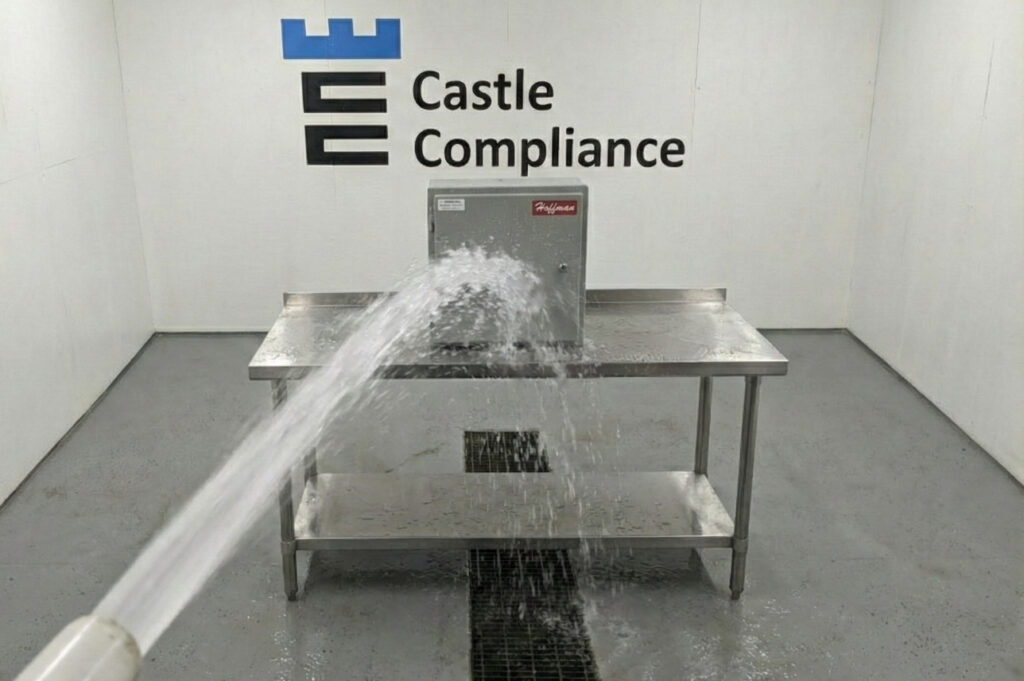
ANSI/NEMA 250 is the premier North American standard for defining the durability and safety of electrical enclosures. While international standards like IEC 60529 focus primarily on blocking solids and liquids (Ingress Protection), NEMA 250 testing takes a holistic approach to environmental survival.
It does not just ask, “Can water get in?” It asks, “Will this enclosure rust after 600 hours of salt spray? Will the gaskets degrade in oil? Can the operator turn the external lever when it is covered in solid ice?”
At Castle Compliance, we provide expert testing to ANSI/NEMA 250-2024, certifying that your equipment is ready for the harsh realities of industrial and outdoor environments.
Beyond Ingress Protection: The NEMA 250 Difference
Many manufacturers assume that an IP rating is equivalent to a NEMA rating. This is a critical mistake.
While there is overlap in testing methodology (e.g., hosedown tests for IP66 and NEMA 4X are similar), NEMA 250 includes environmental durability tests that IEC 60529 ignores entirely.
To achieve a NEMA rating, an enclosure must often pass a battery of additional tests, including:
- Corrosion Protection: 24-hour to 600-hour salt spray tests (ASTM B117) to verify the coating and base material limits.
- Icing: Verifying that external latches and mechanisms remain operable even when the enclosure is coated in ice.
- Gasket Aging & Oil Immersion: Ensuring seals do not degrade when exposed to heat or industrial coolants (ASTM D471).
- Coolant Effects: Specific tests for Type 12 and 13 enclosures involving oil exclusion.
NEMA 250 Enclosure Types Overview
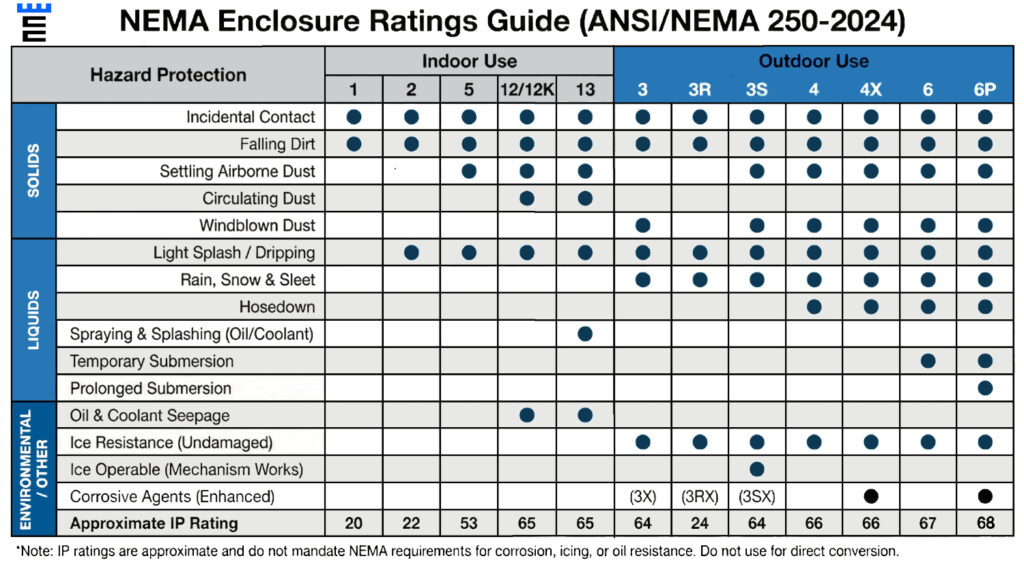
ANSI/NEMA 250 categorizes enclosures based on the specific environmental conditions they are designed to withstand. Unlike the IP Code, which uses a progressive numbering system, NEMA Type numbers are not strictly progressive; each Type represents a specific set of protections for indoor or outdoor applications.
Enclosures for Indoor Locations
These enclosures are designed to provide protection inside facilities where weather exposure is not a factor, but industrial contaminants (dust, oil, coolant) may be present.
- Type 1 Testing: General purpose indoor use. Protects personnel against access to hazardous parts and protects equipment against ingress of solid foreign objects (falling dirt).
- Type 2 Testing: Drip-proof indoor use. Provides the same protection as Type 1, plus protection against the harmful effects of dripping and lightly splashing water.
- Type 5 Testing: Dust-tight indoor use. Protects against falling dirt and settling airborne dust, lint, fibers, and flyings, as well as dripping and light splashing water.
- Type 12 Testing: Industrial indoor use (without knockouts). Protects against circulating dust, falling dirt, dripping and light splashing water, and the seepage of oil and noncorrosive coolants.
- Type 12K Testing: Same as Type 12, but constructed with knockouts.
- Type 13 Testing: Oil-tight industrial indoor use. Protects against dust, spraying of water, and the spraying, splashing, and seepage of oil and noncorrosive coolants.
Enclosures for Indoor or Outdoor Locations
These enclosures are built to withstand weather exposure, including rain, snow, and ice, and can be used in both indoor and outdoor environments.
- Type 3 Testing: Protects against falling dirt, windblown dust, rain, sleet, and snow. It must be undamaged by the external formation of ice on the enclosure.
- Type 3R Testing: Protects against falling dirt, rain, sleet, and snow. Like Type 3, it must be undamaged by external ice formation. (Commonly used for outdoor utility boxes).
- Type 3S Testing: Protects against falling dirt, windblown dust, rain, sleet, and snow. Crucially, the external mechanisms must remain operable even when the enclosure is ice-laden.
- Type 3X Testing: Provides the same protection as Type 3 (dust, rain, sleet, snow, ice accommodation) but adds an increased level of corrosion protection.
- Type 3RX Testing: Provides the same protection as Type 3R (rain, sleet, snow, ice accommodation) but adds an increased level of corrosion protection.
- Type 3SX Testing: Provides the same protection as Type 3S (operability while ice-laden) but adds an increased level of corrosion protection.
- Type 4 Testing: Watertight and dust-tight. Protects against windblown dust, rain, sleet, snow, splashing water, and hose-directed water. It must be undamaged by external ice formation.
- Type 4X Testing: Same as Type 4 (watertight/dust-tight) but adds an increased level of corrosion protection. (Ideally suited for coastal or chemical environments).
- Type 6 Testing: Submersible (Temporary). Protects against hose-directed water and the entry of water during occasional temporary submersion at a limited depth.
- Type 6P Testing: Submersible (Prolonged). Protects against hose-directed water and the entry of water during prolonged submersion. Includes increased corrosion protection.
Enclosures for Hazardous (Classified) Locations
These types are designed for explosive atmospheres. While Castle Compliance specializes in environmental ratings (Types 1–6P, 12, 13), we can guide you on the requirements for these types which reference UL 1203.
- Type 7: Explosion-proof enclosures for indoor use in Class I, Division 1, Groups A, B, C, or D hazardous locations.
- Type 9: Dust-ignition-proof enclosures for indoor use in Class II, Division 1, Groups E, F, or G hazardous locations.
Ancillary Ratings
These optional ratings can be appended to specific Types to denote specialized cleaning capabilities.
- -PW (Pressure Wash): For enclosures capable of withstanding high-pressure power washers (Available for Types 3, 3X, 3S, 3SX, 4, 4X, 6, 6P, 12, 12K, and 13).
- -XH (Corrosive/Hosedown): For indoor enclosures suitable for corrosive and hosedown environments (Available for Types 12, 12K, and 13).
The Physics of NEMA 250 Testing
Passing a NEMA 250 test requires more than just a good seal; it requires robust material selection and engineering. Below are major criteria that apply to NEMA type ratings.
1. The Corrosion Factor: Material Science Meets Compliance
Unlike IP ratings, which ignore material degradation, NEMA 250 requires enclosures to maintain structural integrity despite environmental attack. We evaluate corrosion resistance through three distinct testing tiers, depending on the enclosure’s intended environment.
Tier 1: Indoor Corrosion Protection (Clause 5.8)
Applicability: Types 1, 2, 5, 12, 12K, and 13.
The Test: A 24-hour Salt Spray Test per ASTM B117.
Acceptance Criteria: At the end of 24 hours, the enclosure is washed and dried. It passes if there is no rust visible on the surface.
- Note: Rust is permitted on “impractical” protection points, such as machined mating surfaces, sliding surfaces (hinges), or shafts.
Exemptions (No Testing Required): If your enclosure is made of ferrous metal (steel) that is protected by standard enameling or galvanizing (zinc coating), testing is generally not required. The standard assumes these established industrial finishes provide sufficient indoor protection.
Tier 2: Outdoor Corrosion Protection (Clause 5.9)
Applicability: Types 3, 3R, 4, 6, and all “X” subtypes.
The Test: A rigorous 600-hour Salt Spray Test per ASTM B117.
Acceptance Criteria: This is a comparative test. We test your sample alongside a control sample of G90 galvanized sheet steel. Your enclosure passes if it shows no pitting, cracking, or deterioration more severe than the G90 control sample.
Exemptions (No Testing Required): You can bypass this 600-hour test if your enclosure is constructed from:
- G90 Hot-Dipped Mill-Galvanized Steel: Conforming to ASTM A653.
- Type 304/316 Stainless Steel: Austenitic stainless steels are inherently compliant.
- UL 1332 Approved Paint Systems: If your paint system is already certified for outdoor use on steel enclosures, the physical salt spray test may be waived.
Tier 3: Enhanced “X” Corrosion Protection (Clause 5.10)
Applicability: Only for Types 3X, 3RX, 3SX, 4X, 6P, 12-XH, 12K-XH, and 13-XH.
The Test: A 200-hour Salt Spray Test that is far stricter than the outdoor test because of the control sample used.
Acceptance Criteria: We test your enclosure against a control sample of Passivated AISI Type 304 Stainless Steel. To pass, your enclosure must exhibit zero pitting or cracking more severe than the stainless steel control.
Exemptions (No Testing Required): If your enclosure is fabricated entirely from AISI Type 302, 303, 304, 305, 309, or 316 austenitic stainless steel or polymeric materials (plastics), it is automatically considered compliant.
- Engineering Note: Aluminum and carbon steel (even if painted) generally do not qualify for this exemption and must undergo the full physical test to prove they can match the performance of stainless steel.
2. The Icing Test (Clause 5.6)
For Types 3, 3X, 3R, 3RX, 3SX, 4, 4X, 6, and 6P, the enclosure must survive freezing rain, sleet and snow. Additionally, Type 3S and 3SX external mechanisms must remain operable while ice-laden.
- The Test: We chill the chamber between -3° and -7°C and spray water conditioned between 1°C and 3°C until a solid 20mm layer of ice forms on the enclosure.
- The Criteria: Can a single operator open the door or flip the switch without damaging the mechanism? Is the enclosure undamaged after the ice has melted?
- The Exemption: Enclosures that have no external cavities to trap water when mounted in the normal position are considered acceptable, and testing is not required.
3. Gasket Integrity (Clause 3.14 & 5.14)
NEMA 250 places heavy emphasis on the longevity of the gasket. Unlike IEC 60529, which tests a new enclosure once, NEMA 250 assumes the enclosure must perform for years in hot, industrial environments. We verify this durability through rigorous aging and oil immersion protocols.
The Aging Test (Clause 5.14.2)
Before we even test for water or dust ingress, the gasket material itself must prove it won’t degrade over time.
- Test Overview: We subject the gasket material to a conditioned air oven at a temperature of 69°C to 70°C (156°F to 158°F) for a continuous period of 168 hours (7 days).
- Acceptance Criteria: After aging, the material is inspected and mechanically tested. To pass:
- There must be no visible deterioration, deformation, melting, or cracking.
- Tensile Strength: Must be at least 75% of the value of the unaged material.
- Elongation: Must be at least 60% of the value of the unaged material.
Alternate Evaluation for Complex Gaskets (Clause 5.14.1.1)
Some gaskets, such as foam-in-place gaskets, O-rings, or specific plastic seals, cannot be easily removed or tested as standalone tensile bars.
- The Method: For these materials, we age the entire enclosure (or the assembly containing the gasket) under the same conditions (168 hours at 70°C).
- The Check: Immediately after aging, we subject the assembly to the applicable environmental design tests (e.g., Hosedown or Rain Test). If the aged gasket still seals out water/dust according to its Type rating, it passes.
The Exemption (ANSI/UL 157)
You may not need to pay for this test.
- Criteria: If your gasket material is already certified to ANSI/UL 157 (Gaskets and Seals), and that certification covers the relevant temperature and conditions, you are exempt from the NEMA 250 aging test.
- Note: You must provide the “Yellow Card” or data sheet proving this certification to claim the exemption.
Oil Immersion (Clause 5.14.4)
For industrial Enclosure Types (12, 12K, and 13) likely to be exposed to machining coolants, the gasket faces an additional chemical challenge.
- The Test: Samples are immersed in ASTM Reference Oil No. 3 (or IRM Immersion Oil 903) for 70 hours at room temperature.
- Acceptance Criteria: The gasket must not swell more than 25% or shrink more than 1%.
Not Sure What Tests Apply to your Enclosure?
Navigating the complexities of NEMA 250 can be challenging. Use our interactive NEMA Enclosure Test Navigator to identify your required protection level and see exactly which tests will be required for certification.
NEMA 250 vs. IEC 60529 (IP Code)
A common question we receive is, “Can I convert my IP rating to a NEMA Type?”
The short answer is: No. According to Annex A of ANSI/NEMA 250, you cannot use an IP rating to satisfy a NEMA requirement.
- A NEMA Type 4 enclosure generally meets the requirements of IP66.
- However, an IP66 enclosure does not automatically meet NEMA Type 4 requirements, because the IP rating does not verify protection against corrosion, icing, or gasket aging.
NEMA ratings are “supersets” of protection. If you need dual certification (both NEMA and IP), Castle Compliance can design a single, consolidated test plan to cover both standards efficiently.
Frequently Asked Questions (FAQs)
Both Types are watertight (hose-directed water) and dust-tight. The “X” denotes additional corrosion protection. Type 4 enclosures are typically painted steel, while Type 4X enclosures are usually stainless steel, aluminum, or plastic, making them suitable for harsher corrosive environments.
These are ancillary ratings that can be added to specific enclosure types.
PW (Pressure Wash): Indicates the enclosure can withstand high-pressure power washers (tested per Clause 5.15).
XH: Indicates the enclosure is suitable for corrosive and hosedown indoor environments.
For NEMA 250, we generally recommend testing the enclosure as it will be installed. However, unlike IEC 60529, which has complex acceptance criteria regarding “water contacting live parts,” many NEMA water tests (like the 5.4 Rain Test) simply state: There shall be no accumulation of water within the enclosure. We can discuss whether empty or populated samples are best for your specific project.
Ready to Certify Your Product?
Don’t guess at your durability. Verify it. Contact Castle Compliance today to schedule your NEMA 250 testing.