
ISO 20653 Ingress Protection Testing
Specialized IP Testing for automotive electrical equipment.
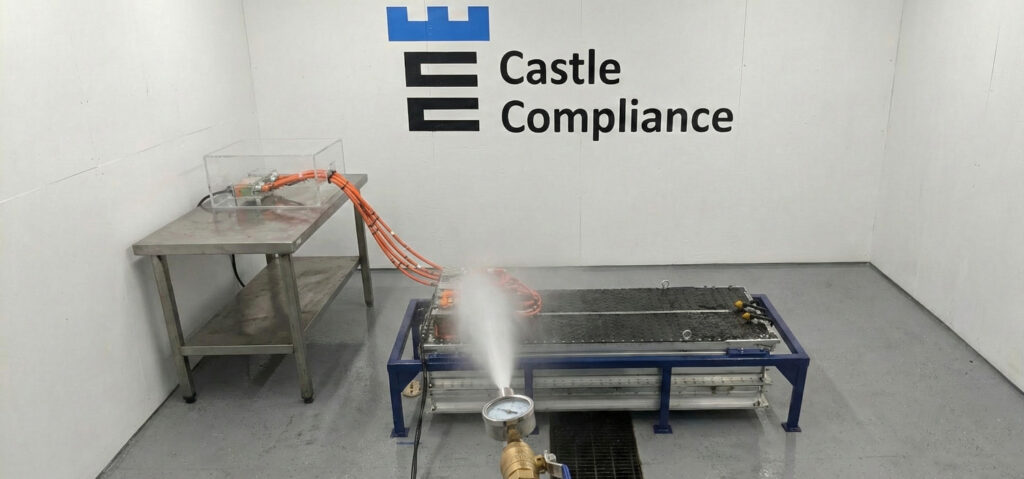
The Standard for Road Warriors
A standard industrial enclosure sits on a wall. Whereas, an automotive component sits on a vibrating chassis, blasting down a highway at 70 MPH, bombarded by gravel, salt spray, and steam cleaners.
ISO 20653 (Road Vehicles – Degrees of protection provided by enclosures) is the specific standard designed to address these harsh dynamic environments. While it shares the same “IP” naming convention as the general IEC 60529 Standard, some test methods are distinct and tailored to the vehicle environment. Charts with details on the standard IP ratings can be found here. The special, ISO 20653 test methods are discussed below.
At Castle Compliance, our ISO 17025 compliant laboratory is equipped to test the full range of ISO 20653 ratings, ensuring your sensors, ECUs, and lighting assemblies are ready for the assembly line and the open road.
The “K” Factor: ISO 20653 vs. IEC 60529
If you see a “K” in an IP rating (e.g., IPX6K, IPX9K, IP6K9K), it refers specifically to ISO 20653 (or the related German DIN 40050-9). This “K” signals that the test requirements have been modified for automotive applications.
Crucial Differences:
- Dust Type (The “Arizona” Difference):
- IEC 60529 uses Talcum Powder. This is a soft, fine powder designed to find microscopic leaks.
- ISO 20653 uses Arizona Road Dust (ISO 12103-1 A2 Fine). This is a gritty, abrasive test medium that simulates real roadway dirt. It tests not just for ingress, but for mechanical jamming and seal abrasion.
- Test Method (No Vacuum):
- Unlike IEC standards which often require pulling a vacuum on the product, ISO 20653 utilizes a pulsing cycle (6 seconds of dust agitation followed by a 15-minute break) to simulate the settling of dust on a vehicle after driving.
IP69K: The High-Pressure Benchmark
The most requested test in the ISO 20653 catalog is IP69K. This rating validates that a component can withstand the aggressive steam-cleaning jets used in car washes and heavy-duty truck maintenance.
Test Parameters:
- Pressure: 80 – 100 bar (1160 – 1450 psi).
- Temperature: 80°C ± 5°C (176°F).
- Flow Rate: 14 – 16 Liters per minute.
- Rotation: The product sits on a turntable rotating at 5 RPM.
- Angles: Sprayed at 0°, 30°, 60°, and 90° for 30 seconds each.
Castle Compliance utilizes dedicated high-pressure steam jet systems capable of holding these precise tolerances to ensure a valid pass/fail result.
ISO 20653 Rating Guide
ISO 20653 introduces several unique ratings that do not exist in the general industrial standards.
Solid Particle Protection (Dust)
| Rating | Description | Method |
| IP5KX | Dust Protected | Tested with Arizona Road Dust (A2 Fine). Dust may enter but not in harmful quantities. Tested for 20 vertical flow cycles. |
| IP6KX | Dust Tight | Test with Arizona Road Dust (A2 Fine). Zero ingress allowed. Tested for 20 vertical flow cycles. |
Liquid Ingress Protection (Water)
| Rating | Description | Method |
| IPX4K | Splash Water (Increased Pressure) | More aggressive than standard IPX4. Pressure is ~ 400 kPa. |
| IPX6K | Strong High-Velocity Water (Increased Pressure) | More aggressive than IPX6. Pressure is ~ 1,000 kPa. |
| IPX9K | High-Pressure / Steam-Jet Cleaning | The ultimate washdown test. Pressure is ~10,000 kPa. |
Common Failure Modes We Help You Fix
Automotive components fail differently than consumer electronics. Our engineering team helps you diagnose:
1. Connector Seal Blowouts
During the IP69K test, the sheer force of the water jet (1450 psi) can physically dislodge gaskets or blast open snap-fit connectors. We help you verify that your connector retention force exceeds the spray impact force.
2. Thermal Shock Breaches
Automotive components are often hot when washed. We can perform testing where the unit is pre-heated before the spray test to simulate the “thermal shock” of a hot engine being steam cleaned, exposing weaknesses in housing materials.
3. Dust Abrasions
Because ISO 20653 uses abrasive Arizona Road Dust, moving parts (like latches or side mirrors) often fail due to jamming or abrasion rather than simple ingress. We inspect for mechanical function, not just dust presence.
Frequently Asked Questions (FAQs)
No.
ISO 20653 explicitly treats these as separate environmental challenges. IP69K tests force/heat/pressure. IP67 tests submersion and sealing time. Most automotive OEMs require a “dual rating” of IP6K9K / IP6K7 to cover both washing and wading (driving through floods).
Yes, absolutely.
An automotive component is rarely installed with an open port. Testing without the mating harness installed is an invalid test configuration. Please send the mating connector with 6+ inches of wire (“pigtails”) so we can seal the cable entry properly.
Yes. ISO 20653 is essentially the international successor to the German DIN 40050-9 standard. The test methods are virtually identical, and we can issue reports referencing either standard depending on your customer’s requirement.
Ready for you PPAP Validation?
Don’t let a test failure stall your production timeline. Contact our engineering team for specialized ISO 20653 testing services.