
IPX3 & IPX4 Spray and Splash Testing
Validating product resilience against rain, sprinklers, and multidirectional splashing.
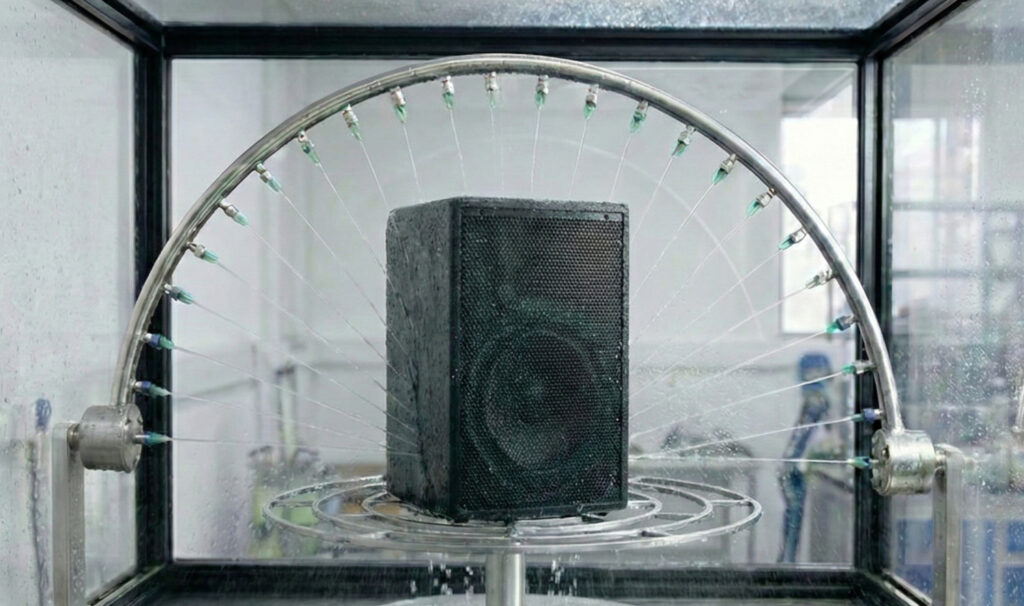
Protection Against the Elements
For outdoor electronics, rain doesn’t just fall straight down—it swirls, splashes, and sprays. IPX3 (Spraying Water) and IPX4 (Splashing Water) are the industry benchmarks for proving your product can survive real-world weather conditions.
Whether you are designing a smart doorbell, an outdoor lighting fixture, or a ruggedized tablet, Castle Compliance provides the precise environmental simulation needed to verify your seals. We utilize both Oscillating Tube systems for high-precision repeatability and calibrated Spray Nozzles for large-scale equipment.
The Tests Explained: IPX3 vs. IPX4
While the test equipment is often the same, the severity and spray angles differ significantly.
IPX3: Spraying Water (Rain Simulation)
This test simulates falling rain acting on a device, possibly with wind blowing it at an angle.
- The Threat: Water falling at an angle up to 60° from vertical.
- Oscillating Tube Method: The tube creates a curtain of water. It oscillates ±60∘ (120° total arc).
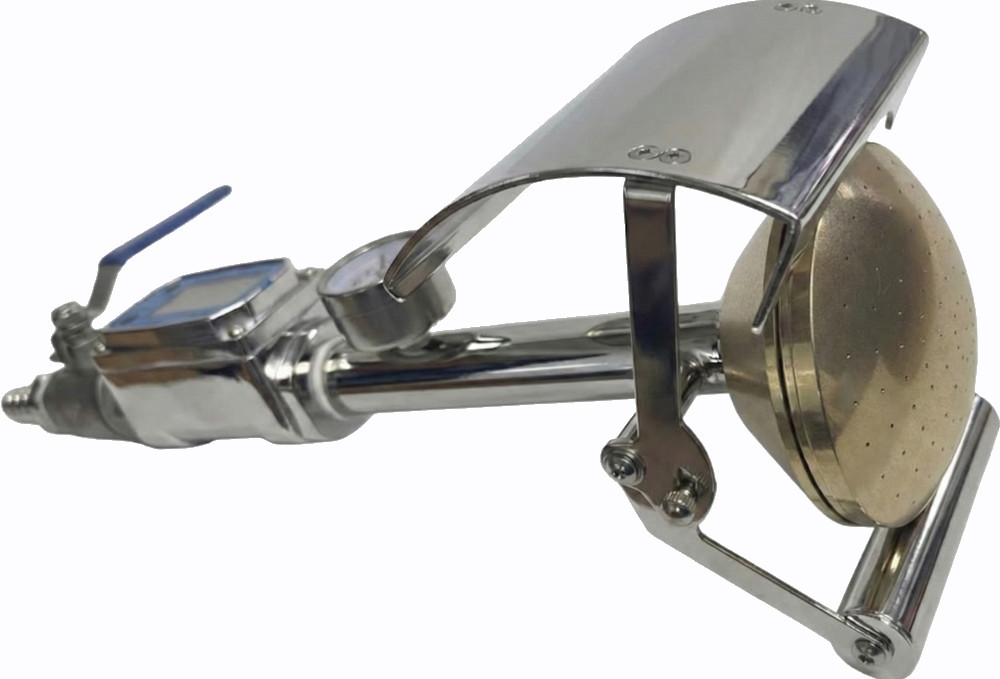
- Spray Nozzle Method: A handheld nozzle with a counterbalanced shield restricts the spray to the same 60° angle.
- Common Application: Street lights, wall-mounted sensors protected by an overhang.
IPX4: Splashing Water (The “360” Test)
This is the standard “Weatherproof” rating. It simulates water splashing against the enclosure from any direction—up, down, or sideways.
- The Threat: Sprinklers, splashing puddles, or heavy storms.
- Oscillating Tube Method: The tube oscillates nearly a full circle (±180∘), soaking the unit from almost every angle.
- Spray Nozzle Method: The shield is removed, and the operator sprays the device from all practicable directions.
- Common Application: Portable speakers, outdoor cameras, camping gear.
Engineering Reality Check: The key difference is the bottom of your device. IPX3 generally allows the bottom to stay dry. IPX4 attacks the device from underneath (splash), meaning bottom vents and cable entries must be sealed.
Our Testing Equipment: Tube vs. Nozzle
IEC 60529 allows for two testing methods. At Castle Compliance, we select the method that best fits your product’s size and geometry.
1. The Oscillating Tube (The “Gold Standard”)
- Best For: Small to medium, relatively symmetrical products.
- How it Works: A motorized hoop swings back and forth around your product.
- Why We Love It: It removes human error. The speed, angle, and distance are mechanically controlled, ensuring 100% repeatability.
2. The Calibrated Spray Nozzle (The “Shower Head”)
- Best For: Large, asymmetrical, or oblong equipment that doesn’t fit inside a tube.
- How it Works: A technician manually sprays the unit using a standardized nozzle (similar to a garden sprayer but calibrated).
- Why We Love It: Flexibility. We can test a refrigerator-sized cabinet or a vehicle component without size constraints.
IPX4K: The Automotive Upgrade
If you are in the automotive sector, you might see a requirement for Splash Water with Increased Pressure – IPX4K (defined in ISO 20653).
- The Difference: Standard IPX4 uses relatively low pressure (approx. 80 kPa). IPX4K increases the pressure significantly (approx. 400 kPa) to simulate road splash at speed. Additionally, the orifice size of each nozzle for IPX4K is larger (0.8mm diameter) vs. each nozzle for IPX4 (0.4mm diameter). The increased pressure through the larger nozzles results in high volumetric flow rate (0.6 liter/minute vs. 0.07 liter/minute). It is noted that the flow rate of IPX4 under IEC 60529 is slightly different than IPX4 under ISO 20653 even though the orifice sizes are the same. IEC 60529 uses has a target flow rate of 0.07 liter/minute whereas ISO 20653 has a target flow rate of 0.1 liter/minute.
- Our Capability: We have the high-pressure pumps required to run this specialized “K” test for automotive clients.
Common Failure Modes
1. The “Breathability” Issue If your unit heats up (like an LED light), the sudden cooling from the spray water creates a vacuum. If you don’t have a pressure-equalizing vent (or if the vent wets out), water will be sucked past the gaskets.
2. Microphone & Speaker Ports For audio devices, the mesh covering the speaker is a critical failure point. IPX4 water can saturate acoustic mesh, leading to temporary audio muffling or permanent ingress. We help you select hydrophobic meshes that repel water while passing sound.
3. Screw Boss Leaks Water often pools in deep screw holes. If the screw doesn’t have an O-ring or sealant, the water eventually migrates down the threads and into the housing.
Validate Your “Weatherproof” Claims
Whether you need a simple IPX3 rain test or a comprehensive IPX4 splash verification, our engineers are ready.