
IP67 Testing Services – Dust Tight & Immersion Protection
Standard: IEC 60529 | Rating: IP67 (Dust Tight + Temporary Immersion)
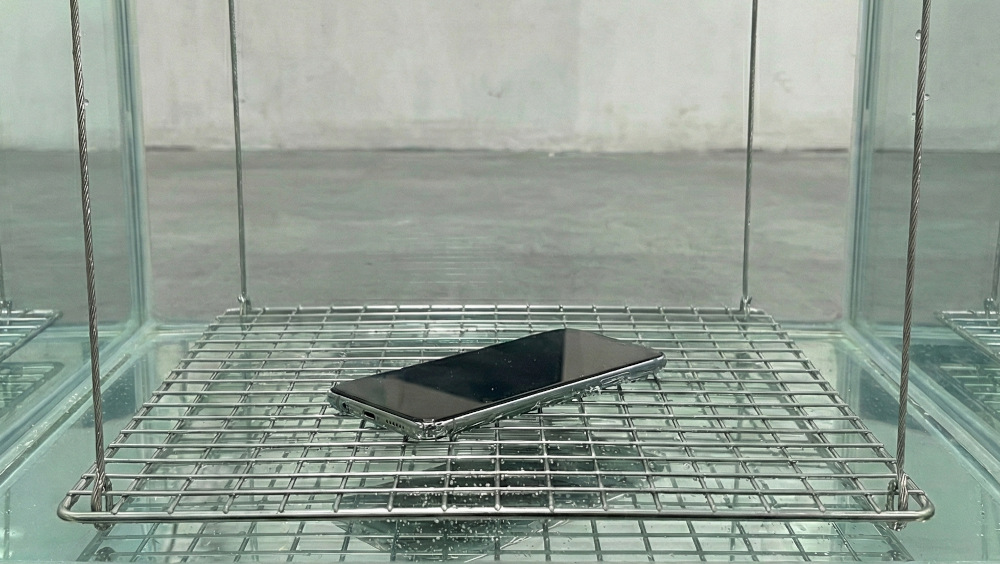
Most testing labs define IP67 simply as “Dust tight and waterproof to 1 meter.” At Castle Compliance, we know that passing this standard requires more than just dunking a box in a tank. It requires mastering the physics of hydrostatic pressure, gasket compression dynamics, and vacuum differentials.
We don’t just test your product; we provide the engineering feedback you need to ensure it survives the real world.
The Technical Definition: What is IP67?
IP67 is a combination of two distinct tests defined by IEC 60529. To achieve this rating, your device must pass both the “6” (Dust) and the “7” (Water) protocols.
1. The “6” (Dust Tight)
This is not a passive settling dust test. It is an active vacuum test.
- The Test: Your device is placed in a dust chamber filled with fine talcum powder (simulating dust particles up to 75 microns).
- The Kicker: For Category 1 enclosures, we connect a vacuum pump to your device to create an internal depression of up to -20 mbar (-2 kPa). We actively attempt to suck dust through your seals for up to 8 hours.
- Pass Criteria: No dust is permitted to enter the enclosure.
2. The “7” (Temporary Immersion)
This tests the integrity of your seals against static water pressure.
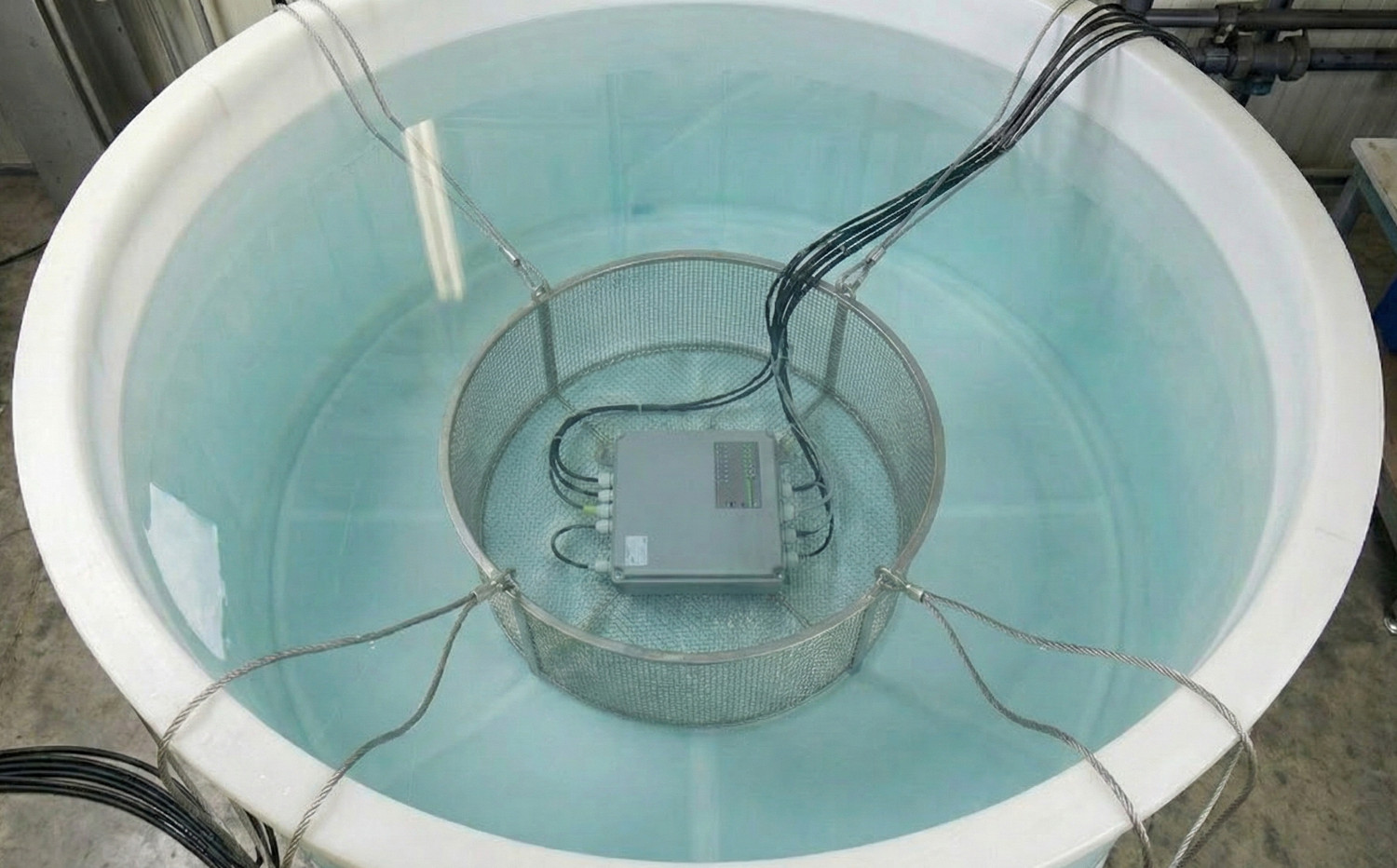
- The Test: The device is submerged in water.
- The Depth: Measured from the bottom of the enclosure (at 1 meter) or the top (at 0.15 meters), whichever is more severe.
- The Duration: 30 minutes.
- Pass Criteria: Water may enter only if it does not interfere with the correct operation of the equipment or impair safety. (Note: We always aim for “Zero water entry” as the best practice).
Engineering Deep Dive: The Physics of IP67 Failures
Most IP67 failures in the lab are not caused by “bad gaskets,” but by a misunderstanding of the forces at play. Below, we break down the specific physics of sealing against temporary immersion.
1. Hydrostatic Pressure & Enclosure Deflection
It is a common error to assume that 1 meter of water pressure is negligible.
- The Physics: At 1 meter depth, hydrostatic pressure (P) is approximately 1.45 psi (0.1 bar).
- The Force Calculation:
(Where F is force, P is pressure and A is area.)
- Example: On a standard 10 x 8 inch enclosure lid (80 in2), the total force is:
1.45 psi x 80 in2 = 116 lbf
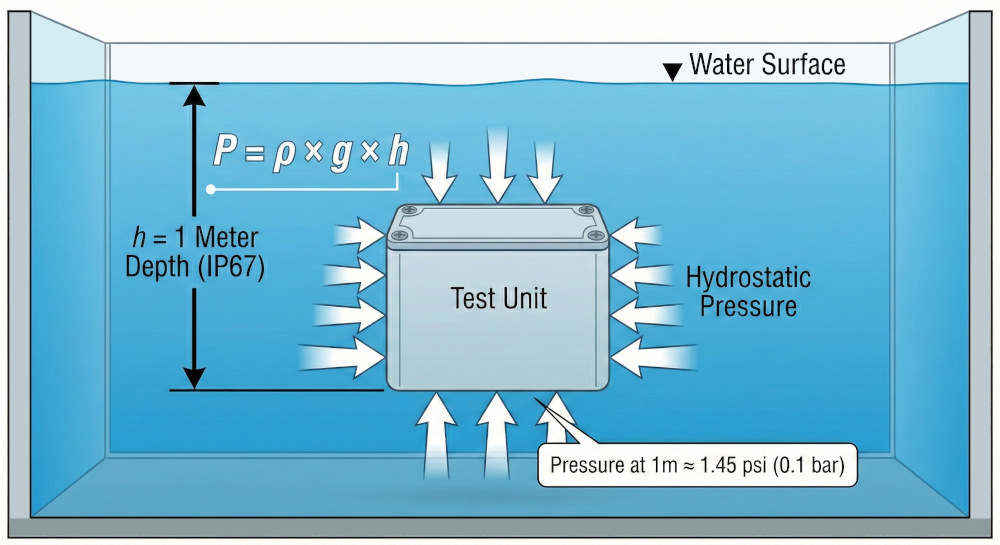
- The Deflection Risk: This 116 lb force is applied uniformly, causing the center of the lid to bow inward. This deflection (𝛿) can be estimated for a rectangular plate (clamped edges) using Roark’s Formulas:
(Where q is pressure, b is width, t is thickness, and E is modulus of elasticity.)
- Understanding ⍺ (The Aspect Ratio Variable): ⍺ is a coefficient that changes based on the shape of your lid (Length divided by Width). A long, skinny lid deflects more easily than a square one.
- Square Lid (Ratio 1.0): ⍺ ≈ 0.0138
- Rectangle (Ratio 1.5): ⍺ ≈ 0.0240
- Long Rectangle (Ratio 2.0): ⍺ ≈ 0.0277
- The Failure Mode: As the center deflects inward, the corners often lever upward (“potato chipping”), reducing gasket compression to zero at the corners.
- Design Recommendation: If your calculated deflection exceeds 50% of your gasket’s compression range, you will leak. Add internal ribs to stiffen the lid rather than just tightening perimeter screws.
2. Material Selection: The Compression Set Trap
Selecting the wrong O-ring material is the leading cause of field failures after the product leaves the lab.
| Material | Temp Range | Compression Set Resistance | Best Application |
| Silicone (VMQ) | -55°C to +200°C | Excellent (Bounces back best) | Plastic enclosures, wide temp cycling, consumer electronics. |
| Nitrile (Buna-N) | -40°C to +100°C | Fair/Good | Oil/Fuel environments. Avoid for hot electronics (takes a “set” quickly). |
| EPDM | -55°C to +150°C | Good | Outdoor/UV exposure. Destroyed by oil/grease. |
| Viton (FKM) | -20°C to +200°C | Good | High chemical resistance. Often too hard (Durometer 75A) for plastic housings. |
The “Durometer” Rule: For plastic enclosures, avoid standard 70 Durometer O-rings. The force required to compress them often warps the plastic lid before the seal is made. Stick to 40-50 Durometer for plastic.
3. Gasket Groove Design (The % Squeeze)
Rubber is incompressible. If you design a groove with 100% fill, the rubber gasket has nowhere to move.
- The Golden Rule: Groove Fill should be < 85%.
- Target Compression:
- Static Seals: 20% – 30% squeeze.
- Dynamic Seals: 10% – 20% squeeze (not applicable for IP67).
- Calculated Squeeze Formula:
- Tip: Always calculate tolerance stack-up. In the “worst case” (loosest groove, thinnest O-ring), you must still have at least 10% compression.
4. The Active Vacuum (Dust) vs. Static Pressure (Water)
IP67 is a contradiction. The “6” (Dust) and the “7” (Water) apply force in different directions.
- IPX7 (Water): External pressure pushes IN (~ 1.45 psi).
- IP6X (Dust): Internal vacuum pulls IN (up to -20 mbar).
- Note: While the vacuum force (-0.3 psi) is lower than water pressure, it is applied for 8 hours.
- Risk: A seal that relies on “self-energizing” (water pressure pushing the lip down) may fail when the pressure is reversed or when subjected to long-duration vacuum.
IP Ratings Compared: Is IP67 “Better” than IP66?
One of the most common misconceptions is that a higher number automatically implies protection against all lower numbers. This is false.
IP67 (Immersion) tests Static Pressure. IP66 (Jets) tests Dynamic Pressure. A device can pass IP67 but leak immediately when sprayed with a hose (IP66).
| Rating | Protection Type | The Test Scenario | The Key Difference |
| IP67 | Temporary Immersion | Submerged to 1 meter for 30 minutes. | Protects against being underwater. Does not guarantee protection against high-pressure jets. |
| IP68 | Continuous Immersion | Submerged deeper than 1m (e.g., 2m) for a duration agreed by manufacturer. | Not a fixed standard. You must define the depth/time. If undefined, IP68 is meaningless. |
| IP65 | Low-Pressure Jets | 6.3mm nozzle spray. | Simulates rain and light hose-down. IP67 does not automatically cover this. |
| IP66 | High-Pressure Jets | 12.5mm nozzle spray. | Simulates powerful hose-down. Dynamic pressure can blast open IP67 seals. |
Pro Tip: If your product will see rain and puddles, request IP66/IP67 dual testing.
Prepare for Your Test: The “Pass First Time” Checklist
Save time and money by sending the right samples the first time.
1. What to Ship:
- 2x Functional Units: Please provide one primary unit and one backup unit.
- Why? It is common for prototypes to have minor assembly defects (e.g., a pinched wire or debris on a gasket) that cause a leak unrelated to the design. If Unit 1 fails, we can immediately inspect it and test Unit 2. This verifies if the failure was a fluke or a design flaw, keeping your project on schedule without waiting for return shipping.
- One of the functional units can be used for the IP6X (Dust) test. Please note that we may need to drill a small hole in a unit to attach our vacuum lines.
- 1x Empty Housing (Optional): An empty housing can be used for the IP6X (Dust) test. Furthermore, having an empty housing available can be helpful during troubleshooting in the event that there is a water or dust leak.
- Spare Gaskets: If a unit fails due to a seating issue, having a spare gasket allows us to re-seat and re-test immediately.
- Mating Connectors, Harnesses, Cables, Caps, etc.: Provide any connectors and/or cables necessary to seal your unit as it would be in service. Moreover, we will need these for performing functional checks. Any cables or harnesses that need to be in place during testing should be a minimum of 1 meter long to reach out of the water. Longer is fine. Alternatively, provide dummy connectors and/or cables that are sealed.
- Support Equipment: You will need to send any support equipment necessary to check functionality of your unit. Contact us to coordinate on precisely what should be sent. We may be able to use some of our equipment (e.g., power supply, computer, etc.) to reduce what needs to be shipped.
2. Configure Your Unit:
- Ensure all ports (USB, Ethernet) are capped or sealed as they would be in the field.
- If you use Gore/ePTFE vents, ensure they are rated for immersion (High WEP), not just airflow.
Frequently Asked Questions
“Waterproof” is a marketing term, not an engineering one. IP67 means it can withstand temporary submersion. It does not mean it can withstand immersion for extended durations. Nor does it mean it can withstand high-pressure washing (IP69K) or deep diving (IP68).
No. The pressure of a pressure washer exceeds the static pressure of 1 meter of water. You need IP69 testing for that.
No. In order to legitimately qualify for protection against water spray in addition to immersion you will need a dual rating of IP66 / IP67.
If a hot device is dunked in cold water, the internal air contracts, creating a vacuum that sucks water in. Per IEC 60529, the water temperature needs to be within 5K of the devices temperature. However, a modified requirement may be specified in the relevant product standard if the tests are to be made when the equipment is energized. We recommend testing at the device’s operating temperature to simulate this real-world thermal shock.
Ready to Certify Your Design?
Don’t guess with your IP rating. Partner with a lab that understands the physics of enclosure sealing.