
IP Testing Services – Dust Tight & Powerful Water Jets
Standard: IEC 60529 | Rating: IP66 (Dust Tight + Powerful Water Jets)
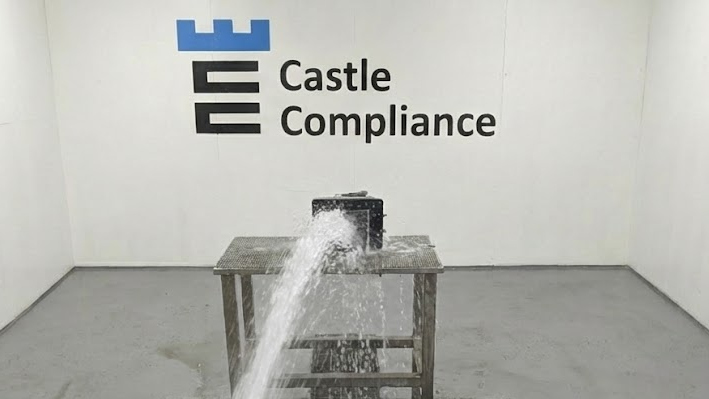
Many manufacturers assume that if a product passes an immersion test (IP67), it will easily pass a hose-down test (IP66). This is a dangerous misconception. IP66 testing introduces high-velocity dynamic pressure that can blast open seals which remain perfectly watertight underwater.
At Castle Compliance, we understand that passing IP66 testing requires mastering dynamic gasket deflection, nozzle impact forces, and vent shielding. We don’t just hold the hose; we provide the engineering feedback necessary to ensure your enclosure survives heavy seas, industrial washdowns, and powerful storms.
The Technical Definition: What is IP66?
IP66 is a rating for the level of protection against solid objects and water as defined by international standard IEC 60529. To achieve this rating, your device must prove it is completely sealed against dust and resilient against powerful water jets.
1. The First Numeral “6” (Dust Tight)
Just like IP67, the first digit represents the highest level of solid particle protection.
- The Test: Your device is placed in a dust chamber using fine talcum powder (particles < 75 microns).
- The Vacuum: For Category 1 enclosures, we attach a vacuum pump to your device to create an internal depression of up to -20 mbar (-2 kPa). This actively attempts to suck dust through your seals for up to 8 hours.
- Pass Criteria: Zero dust ingress is permitted.
2. The Second Numeral “6” (Powerful Water Jets)
This tests the mechanical strength of your seals against high-volume, high-velocity water.
- The Nozzle: A standard 12.5mm nozzle (approx. 0.5 inch).
- The Flow Rate: A massive 100 liters per minute (26.4 gallons per minute).
- The Distance: Sprayed from 2.5 to 3 meters away.
- The Duration: 1 minute per square meter of enclosure surface area (minimum 3 minutes).
- Pass Criteria: Water may enter only if it does not interfere with the correct operation of the equipment or impair safety.
Engineering Deep Dive: Why Products Fail IP66 Testing
IP66 testing failures are rarely about the “amount” of water; they are about the force of the water. Below, we break down the physics that differentiate a successful IP66 design from a leaky one.
1. Dynamic Pressure vs. Static Pressure
This is the primary reason devices that pass IP67 (Immersion) fail IP66 (Jets).
- Static Pressure (IP67): When submerged, water pushes uniformly on all sides of the enclosure. This uniform pressure often helps “energize” seals, pushing the lid tighter against the housing.
- Dynamic Pressure (IP66): A water jet applies a focused, high-velocity force to a specific point.
- The Failure Mode: If the jet hits the seam between the lid and the housing, the kinetic energy can lift the lid slightly or “peel” the gasket lip backward, opening a momentary gap.
- Design Fix: Interlocking tongue-and-groove designs are superior to flat gaskets for IP66 because they shield the rubber from direct jet impact.
2. The “Water Hammer” Effect
When a 100 L/min jet strikes a flat surface, the damage isn’t caused just by the volume of water, but by the dynamic pressure spike.
- The Impact Force: The jet hits your enclosure with a continuous force of approximately 23 Newtons (5.1 lbf). While this total load is manageable for most mounting hardware, it is deceptive.
- The Pressure Spike: The real threat is the localized Stagnation Pressure. As the water velocity (~ 13.6 m/s) is instantly brought to zero against your housing, it generates a pressure peak of roughly 100 kPa (14.5 psi) at the point of impact.
- The Failure: This 14.5 psi spike “hammers” the sealing face. If your gasket compression force is lower than this dynamic pressure, the seal will momentarily burp, allowing water ingress—even if the box is mechanically secure.
3. Venting Vulnerabilities (ePTFE)
Protective vents (like Gore patches) that “breathe” air but block water are excellent for IP67, but dangerous for IP66 testing.
- The Risk: Most adhesive vents are rated for immersion (static pressure). A direct hit from an IP66 water jet can blast the adhesive off the enclosure or mechanically puncture the membrane.
- Design Recommendation: If you require IP66 and venting, you must use a protective cowl or labyrinth design over the vent. You cannot leave the membrane exposed to the direct line of fire of the nozzle.
IP Ratings Compared: IP65 vs. IP66 vs. IP67
It is critical to choose the test that matches your product’s real-world environment.
| Rating | Protection Type | Test Scenario | Key Difference |
| IP65 | Water Jets | 6.3mm Nozzle @ 12.5 L/min | Simulates rain or a garden hose. Standard for outdoor lights. |
| IP66 | Powerful Jets | 12.5mm Nozzle @ 100 L/min | 8x the water volume of IP65. Simulates heavy seas or industrial cleaning. |
| IP67 | Immersion | Submerged 1m Deep | Static pressure. Often easier to pass than IP66 for rigid enclosures. |
| IP69 | High Temp/Pressure Jets | 80°C Water @ ~ 1450 psi | Steam cleaning. Requires specialized high-temp gaskets. |
Pro Tip: If your product is mounted on a vehicle or ship deck, IP66 is usually the correct standard, not IP67.
Prepare for Your Test: The “Pass First Time” Checklist
To ensure a smooth testing process at Castle Compliance, please review this checklist before shipping your samples.
1. What to Ship:
- 2x Functional Units: One primary and one backup. If the primary fails, we can immediately test the backup to rule out assembly errors vs. design flaws.
- 1x Empty Housing: Extremely useful for the IP6X dust test and for leak tracing without risking expensive electronics.
- Mating Connectors: All ports must be sealed. If you use waterproof connectors, provide the mating cables (at least 1 meter long). If ports are unused, ensure caps are torqued to spec.
- Gasket Spares: If your design allows for field-replaceable gaskets, send spares. We can swap them out if a specific unit was assembled incorrectly.
- Mating Connectors, Harnesses, Cables, Caps, etc.: Provide any connectors and/or cables necessary to seal your unit as it would be in service. Moreover, we will need these for performing functional checks. Alternatively, provide dummy connectors and/or cables that are sealed.
- Support Equipment: You will need to send any support equipment necessary to check functionality of your unit. Contact us to coordinate on precisely what should be sent. We may be able to use some of our equipment (e.g., power supply, computer, etc.) to reduce what needs to be shipped.
2. Configure Your Unit:
- Torque Specs: Please provide the specific torque settings for your enclosure screws. Over-torquing is a common cause of distorted housings and leaks.
- Cable Glands: Ensure all cable glands are tightened around a cable of the correct diameter. A gland tightened on “nothing” will leak.
Frequently Asked Questions (FAQs)
Yes. IP66 uses a nozzle with a larger diameter (12.5mm vs 6.3mm) and delivers nearly 8 times the volume of water (100 L/min vs 12.5 L/min). A product that passes IP66 will almost certainly pass IP65, but the reverse is not true.
No. This is a major point of confusion. IP67 tests submersion; IP66 tests high-velocity spray. Many enclosures seal well under the uniform pressure of water (IP67) but fail when a jet blasts the seal from the side (IP66). You need dual certification (IP66/IP67) for full coverage.
Generally, no. An exposed membrane vent will likely be damaged by the force of the 100 L/min jet. You must design a cover or baffle to deflect the direct energy of the water stream away from the vent.
No. A commercial pressure washer operates at pressures vastly higher than IP66. For pressure washer protection, you need IP69K testing.
Ready to Certify Your Design?
Don’t let a failed test delay your launch. Partner with the lab that helps you engineer a better product.