
Solid Particle Protection Testing (IP1X – IP4X)
Verify your enclosure protects users from shock hazards (Access) and protects equipment from foreign debris (Solid Objects).
The “Gatekeeper” of Ingress Protection
Before an enclosure can be rated for dust (IP5X) or water (IPX4), it must first pass the fundamental requirement: Physical Integrity.
The lower numerals of the IP Code (IP1X through IP4X) are the frontline defense for product safety. Defined by IEC 60529, these ratings verify two distinct but critical safety factors:
- Object Protection: That solid foreign objects (rocks, screws, wires) cannot enter the enclosure and damage internal mechanics.
- Access Protection: That users cannot touch hazardous live parts or moving gears with their hands, fingers, or tools.
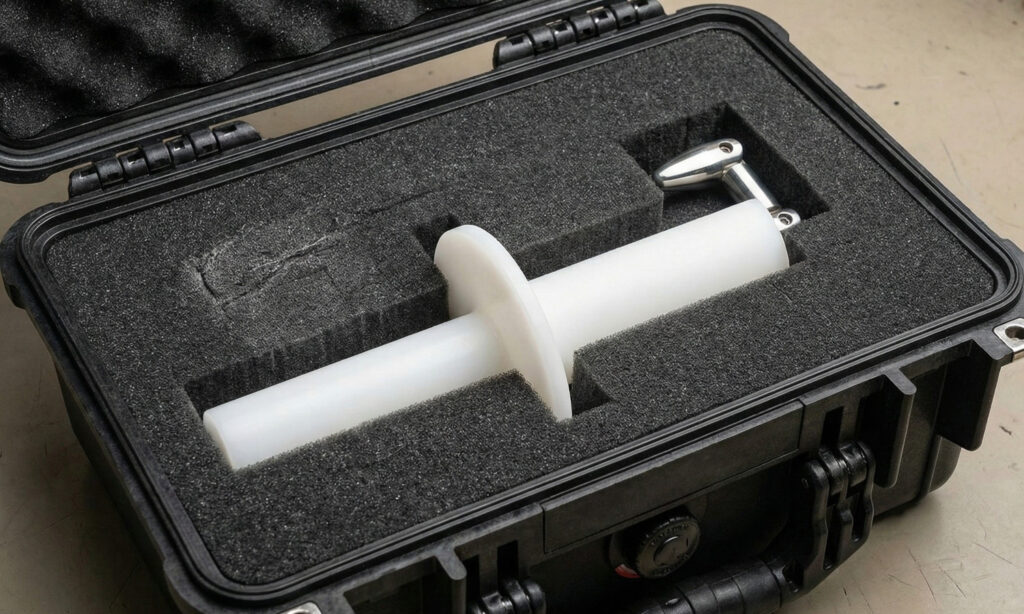
At Castle Compliance, we view these tests as the essential “pre-scan” for high-performance enclosures. We use calibrated NIST-traceable test probes with precise force gauges to ensure your product meets the strict dimensional and safety requirements of the standard.
The Prerequisite Rule: Why IP4X Matters for IP6X
A common misconception is that if you request IP6X (Dust Tight) testing, we skip the probes and go straight to the dust chamber. This is incorrect.
The Hierarchy of Compliance: According to IEC 60529, an enclosure designated with a specific numeral implies compliance with all lower degrees of protection.
- The Implication: If you claim IP6X, you are implicitly claiming IP4X, IP3X, IP2X, and IP1X.
- The Safety Check: Before we place your unit in a dust chamber, we verify it with the IP4X Probe (1.0mm Wire). If the wire enters, the unit automatically fails the higher ratings. You cannot be “Dust Tight” if you have a hole big enough for a wire.
One Rating, Two Tests: The Dual Requirements
To pass a First Characteristic Numeral (1, 2, 3, or 4), your product must pass two distinct test methods defined in the standard:
- Protection Against Solid Foreign Objects: Prevents the ingress of inorganic debris.
- Protection Against Access to Hazardous Parts: Prevents a human body part or hand-held tool from touching hazardous live parts (shock) or moving mechanical parts (injury).
We use the specific Object Probes and Access Probes required for each rating to validate both.
Protection Against Solid Foreign Objects (The “Object” Test)
This test determines if solid debris can enter the enclosure. The rigid object probe is pushed against every opening in the enclosure with a specific force defined in Table 7 of the standard.
| Rating | Object Size | Object Probe | Test Force | Pass Criteria |
| IP1X | Large objects | 50 mm Rigid Sphere | 50 N ±10% | Sphere must not fully penetrate. |
| IP2X | Medium objects | 12.5 mm Rigid Sphere | 30 N ±10% | Sphere must not fully penetrate. |
| IP3X | Small objects | 2.5 mm Rigid Rod | 3 N ±10% | Rod must not penetrate at all. |
| IP4X | Granular/wire | 1.0 mm Rigid Steel Wire | 1 N ±10% | Wire must not penetrate at all. |
Protection Against Access to Hazardous Parts (The “Access” Test)
This test determines if a person can touch something dangerous inside. The access probe is pushed against or inserted through openings. For low-voltage equipment, we use a low-voltage electrical circuit (40V-50V) connected to the probe and the internal parts. If the probe touches a live part, the light turns on, and the unit fails.
| Rating | Protected Against | Access Probe | Test Force | Pass Criteria |
| IP1X | Back of hand | 50 mm Sphere w/ Handle | 50 N ±10% | Adequate clearance from hazardous parts. |
| IP2X | Human finger | Jointed Test Finger | 10 N ±10% | Adequate clearance from hazardous parts. |
| IP3X | Tool | 2.5 mm Test Rod | 3 N ±10% | Probe shall not penetrate. |
| IP4X | Wire | 1.0 mm Test Wire | 1 N ±10% | Probe shall not penetrate. |
Deep Dive: IP4X (The Wire Test)
IP4X is one of the most frequently requested ratings for outdoor electrical cabinets, junction boxes, and HVAC equipment. It represents the threshold where an enclosure stops “objects” and starts stopping “particles.”
Why IP4X Matters:
- Insect Protection: A 1mm limit is generally sufficient to stop ants, wasps, and spiders from nesting inside equipment and causing short circuits.
- Wire Protection: Prevents stray wires or clippings (common in installation sites) from falling into the enclosure.
- The Test: We use a 1.0mm rigid steel wire. The force is low (1 Newton), but the tolerance is zero. If the wire enters the enclosure at any angle, the unit fails.
Deep Dive: IP2X (The Finger Test)
IP2X is the global benchmark for “Finger Safe” electrical equipment. It is often misunderstood because it requires two completely different probes.
Test A: The Object Test (Rigid Sphere)
- Probe: A 12.5mm solid steel ball (marble sized).
- Force: 30 Newtons (~6.7 lbs).
- Goal: To ensure structurally, the holes are small enough to block large debris.
Test B: The Access Test (Jointed Finger)
- Probe: A specialized metal finger with two joints (knuckles) that can bend 90 degrees.
- Force: 10 Newtons (~2.2 lbs).
- Goal: To simulate a curious person trying to “hook” their finger around a baffle to touch a wire.
- The “Gotcha”: Even if the opening is small, if we can wiggle the 80mm long finger inside and touch a capacitor, you fail.
Validate Your Safety Compliance
Ensure your product is safe for human interaction and compliant with IEC 60529. Contact our engineering team to schedule your IP1X-IP4X testing.