
IEEE 299-2006 Testing & Consulting
Validate enclosure shielding and protect sensitive electronics with confidence.
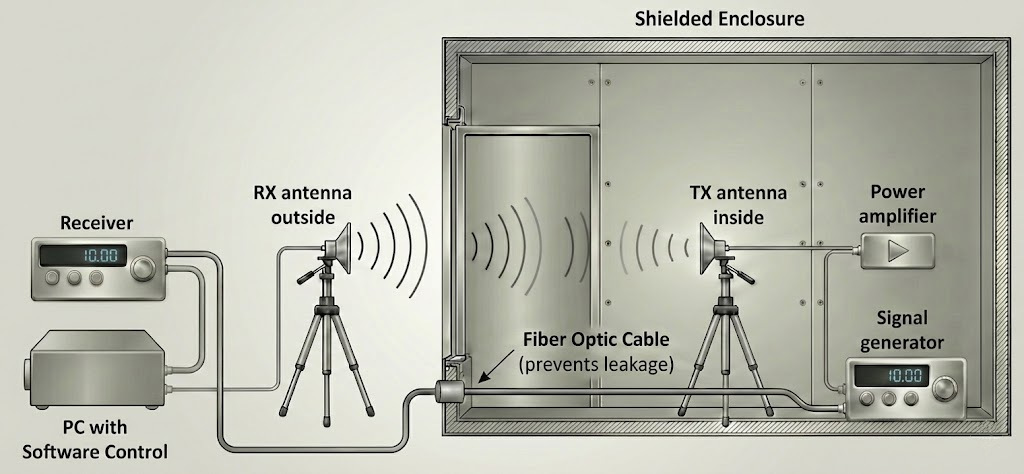
IEEE 299-2006, titled “Standard Method for Measuring the Effectiveness of Electromagnetic Shielding Enclosures”, is a leading reference for testing shielded rooms, buildings, or containers. It provides a structured approach to assessing shielding effectiveness (SE) across a broad frequency range, ensuring that your enclosure meets rigorous attenuation goals.
At Castle Compliance, we operate as an extension of your engineering team. Below, we unpack the key elements of IEEE 299-2006, its typical applications, and how our services support efficient and accurate compliance.
What Is IEEE 299-2006?
IEEE 299-2006 sets standardized procedures for measuring the shielding effectiveness of full-scale enclosures. It is widely used by defense, telecom, data center, and secure facility engineers to verify that internal or external RF signals remain isolated.
Standard Scope & Key Focus Areas
- Frequency Range: The standard covers frequencies from as wide as 10kHz to 40GHz, ensuring comprehensive EM field attenuation testing.
- Enclosure Types: Applicable to rooms, shielded cabinets, or entire building spaces.
- Measurement Methods: It specifies antenna placements, reference field strengths, calibration, and how to record attenuation in decibels (dB).
- Repeatability: The standard ensures consistent test setups, which is essential for comparing different facilities or validating post-construction improvements.
Why It Matters
- EMC & Security: Prevents undesired signals from leaking out or external interference from coming in.
- Data Integrity: Maintains reliable operation of sensitive equipment or confidential data lines (e.g., SCIFs, secure comms).
- Regulatory Compliance: Many government and industry contracts reference IEEE 299 to confirm minimal signal leakage.
Typical Test Procedures & Frequency Ranges
IEEE 299-2006 outlines a systematic set of measurements to ensure even high-frequency waves are sufficiently attenuated.
| Range | Typical Frequency | Purpose |
| Low-End | 10kHz – 30MHz | Evaluates how the enclosure handles lower-frequency magnetic fields. |
| Mid-Range | 30MHz – 1GHz | Crucial for radio and TV bands, as well as critical communication signals. |
| High-End | 1GHZ – 40GHz | Covers modern wireless signals, including Wi-Fi, radar bands, and cellular networks. |
Field Probing & Antenna Placement: The test typically utilizes an “Inside/Outside” approach, placing a reference antenna outside the enclosure and a receiving antenna inside (or vice versa). The measured attenuation in dB indicates exactly how much the shield reduces the incident signal.
Who Uses IEEE 299-2006 Testing?
- Secure Facilities & SCIFs: Government or intelligence rooms needing minimal EM leakage for confidentiality.
- Data Centers & Server Rooms: Facilities looking to prevent external interference or contain internal noise.
- R&D Labs & Anechoic Chambers: Environments that must ensure minimal cross-interference during testing.
- Industrial/Commercial Complexes: Sites protecting critical equipment from external EMI or limiting emissions for compliance.
Our IEEE 299-2006 Testing & Consulting Services
We offer a holistic approach, integrating shielding effectiveness with broader EMI/EMC strategies like MIL-STD-188-125, MIL-STD-285 or NSA 94-106.
Enclosure Design & Material Selection
- Material Advice: We advise on metals, composites, or specialized coatings that yield high shielding attenuation.
- Component Selection: We recommend door seals, waveguide vents, cable penetrations, and modular panel systems.
Sample Prep & Fixture Guidance
- Pre-Check: We ensure correct sample dimensions, thickness, and edge handling to avoid misreads.
- Calibration: We provide fixture calibration tips, including methods for verifying baseline insertion loss.
Test Plan Development
- Custom Protocols: We define frequency ranges, antenna positions, and instrumentation per IEEE 299 guidelines.
- Pass/Fail Criteria: We outline criteria based on your project’s specific security or performance needs.
On-Site Testing & Troubleshooting
- Travel to Site: We travel to your facility to evaluate and test the enclosure in-situ.
- Real-Time Interpretation: We perform testing and real-time data interpretation under IEEE 299-2006 procedures.
- Troubleshooting: If we identify weak points (seams, door gaskets, cable feedthroughs), we suggest design improvements like conductive gaskets or improved welds to mitigate leaks.
Frequently Asked Questions (FAQ)
IEEE 299 focuses on full-scale enclosures (rooms or large cabinets), while ASTM D4935 typically measures planar materials in a smaller fixture. If you need raw material data, ASTM D4935 is more relevant; for entire enclosures, IEEE 299 is the go-to standard.
Usually, no. IEEE 299 is typically done in-situ, placing antennas inside and outside the actual enclosure. Portable test gear and structured procedures allow us to achieve accurate results without a massive external chamber.
Not always. Many companies adopt IEEE 299 voluntarily for performance verification or when contractual clauses reference it. However, certain secure or high-tech facilities may require it by policy.
The standard outlines a systematic set of positions around the enclosure—often corners, seams, doors, and vents. We finalize a plan that balances thorough coverage with practical time constraints.
Ready to Ensure Your Enclosure Meets IEEE 299-2006 Standards?
Don’t let hidden leaks compromise your EMI/EMC integrity or data security.
Contact us today to learn how our IEEE 299-2006 testing and consulting services can help you build or validate robust shielded enclosures, protecting critical systems and meeting stringent industry requirements.