
ASTM D4935 Shielding Effectiveness Testing & Consulting Services
Accurately measure the shielding effectiveness of planar materials across critical frequency ranges.
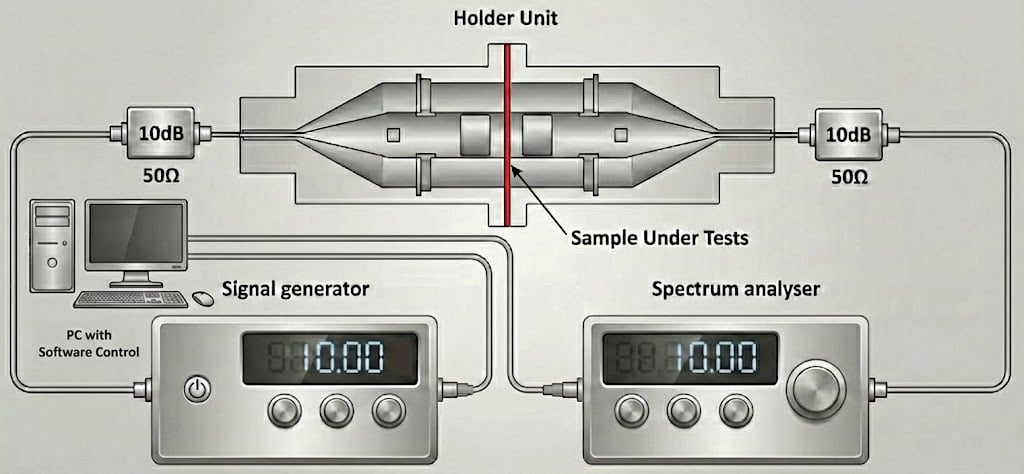
ASTM D4935 is the industry standard test method focused on determining the electromagnetic (EM) shielding performance of flat, planar materials, such as fabrics, foils, and composites. Whether you are exploring novel materials for EMI suppression or verifying an existing solution’s performance, this test provides a reliable, repeatable benchmark.
At Castle Compliance, we guide you through the entire process—from material selection and sample preparation to lab testing and data interpretation.
Get a customer testing plan and pricing within 24 hours.
Our ASTM D4935 Services
Material Selection & Design
We offer a comprehensive suite of services, from design consulting to final lab testing.
- Custom Recommendations: We recommend conductive fibers, fillers, or coatings that align with your specific target frequency range.
- Layering Strategy: We suggest layering strategies (e.g., multi-laminates) to boost attenuation in critical bands.
Sample Prep & Fixture Guidance
- Precision Prep: We ensure correct sample dimensions and thickness to avoid misreads.
- Calibration: If you have internal capabilities, we provide fixture calibration tips and methods for verifying baseline insertion loss.
Laboratory Testing
- Mail-In Service: You send your material samples to our lab. Expedited testing is available.
- Execution: We handle the scheduling, testing, and real-time data interpretation under strict ASTM D4935 procedures.
- Analysis: We review the raw data to identify anomalies, such as resonance dips or issues with clamp pressure.
Integration with Larger Systems
Once your material is validated, we help translate that performance to full enclosures, bridging the gap to standards like IEEE 299 or MIL-STD-285.
What Is ASTM D4935?
ASTM D4935 is titled the “Standard Test Method for Measuring the Electromagnetic Shielding Effectiveness of Planar Materials”. Unlike enclosure standards, this method is specifically designed to evaluate raw materials before they are integrated into a final product.
Standard Scope & Key Focus Areas
- Material-Level Testing: Suitable for metalized textiles, conductive polymers, thin foils, or layered composites.
- Frequency Range: The standard typically covers frequencies from 30 MHz up to 1.5 GHz. However, with advanced instrumentation, we can extend this range to 10 GHz or higher.
- Measurement Metrics: It evaluates shielding effectiveness (SE) in decibels (dB), indicating exactly how much the material attenuates EM fields.
- Controlled Setup: Testing uses a specific coaxial transmission line fixture, which ensures repeatable sample mounting and minimizes edge effects that could skew results.
Why It Matters
- Material R&D: Ideal for laboratories developing new shielding fabrics or coatings.
- Precursor to Full Systems: Verifying material performance early allows you to integrate it confidently into larger systems, such as shielded rooms or cabinets.
- Industry & Defense: Mission-critical designs in aerospace and defense rely on robust EMI attenuation validated at the material level.
Who Uses ASTM D4935 Shielding Effectiveness Testing?
- Textile Manufacturers: For developing conductive or metalized fabrics used in anti-static garments or protective curtains.
- Electronics & PCB Suppliers: For testing copper-laminated foils, shielding tapes, and specialty coatings.
- R&D Labs: For investigating novel composite layers to improve EMI performance.
- Defense & Aerospace: For evaluating lightweight shielding solutions intended for portable or airborne electronics.
ASTM D4935 Test Procedures & Methodology
ASTM D4935 outlines a rigorous protocol to ensure that data is consistent and reliable.
1. Sample Preparation
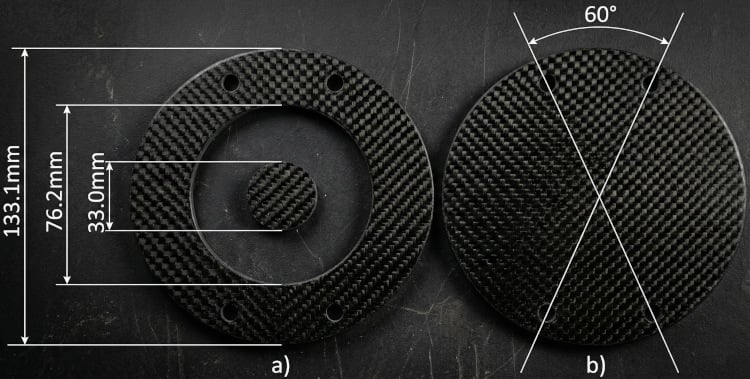
Detailed preparation is critical for accuracy. Materials must be cut into standard circular or rectangular shapes to fit the test fixture’s aperture.
- Edge Treatment: We ensure proper edge handling to avoid fraying, which leads to inconsistent contact.
- Uniformity: Samples must have consistent thickness to prevent gaps or folds.
Below is an example of circular material specimens machined to the required dimensions for ASTM D4935 testing.
a) Reference Specimen
b) Load Specimen
2. The Test Fixture
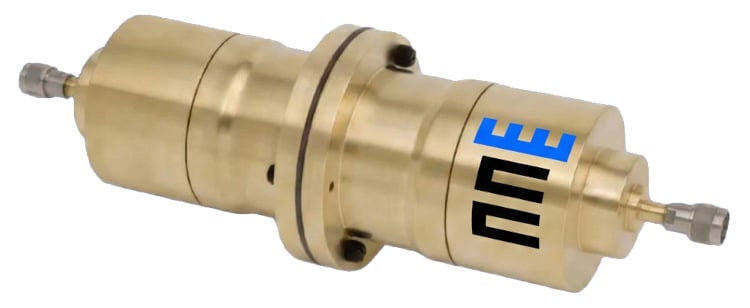
The test utilizes a flanged coaxial transmission line fixture. The sample is placed between the fixture halves, creating a controlled environment for the EM waves to pass through.
3. Frequency Sweep & Data Analysis
- Sweep: We typically measure from 30 MHz to 1.5 GHz, with options to push beyond 3 GHz for high-end applications.
- Insertion Loss: The equipment measures insertion loss in dB, representing how well the sample blocks the signal.
- Calculation: SE is calculated by comparing the signal strength with the material against a baseline measurement without the material.
Frequently Asked Questions (FAQ)
ASTM D4935 tests planar materials (raw sheets, textiles) in a small coaxial fixture. IEEE 299 targets enclosure-scale performance, measuring entire rooms, cabinets, or buildings.
Yes. While the standard defaults to 30 MHz–1.5 GHz, our advanced instrumentation allows us to push testing up to 10 GHz or higher with proper calibration.
Yes. Uniform edges, consistent thickness, and secure fixture contact are crucial. Folds, wrinkles, or loose edges can create unintended gaps that skew your data.
We recommend testing multiple samples from different production batches. This yields more reliable data, especially if the material’s composition or thickness varies during manufacturing.
Ready to Evaluate Your Planar Materials?
Don’t let guesswork guide your EMI solutions.
Contact Castle Compliance today to learn how our ASTM D4935 shielding effectiveness testing and consulting services can provide the precise, repeatable data you need to develop effective shielding fabrics, foils, and composites.