
IP68 Testing Services – Continuous Immersion Protection
Standard: IEC 60529 | Rating: IP68 (Dust Tight + Continuous Immersion)
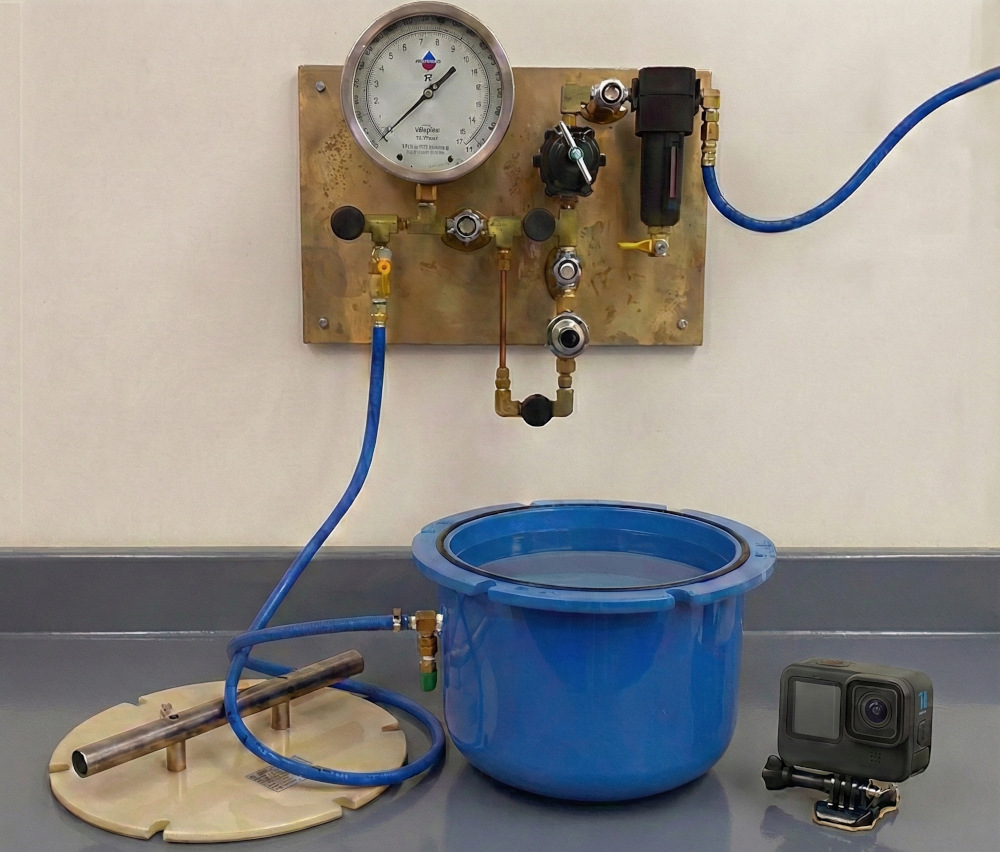
“IP68” is the most complex rating in the ingress protection world. Unlike IP67, which has a fixed definition (1 meter), IP68 is an agreement between the manufacturer and the test lab. It means “protection against continuous immersion,” but the depth and duration are variables that you must define.
At Castle Compliance, we help you navigate this spectrum—from the “bare minimum” 1.1-meter check to the “flagship standard” of 6 meters and beyond.
The Technical Definition: What is IP68?
IP68 is one of the ratings within the Ingress Protection (IP Code), as defined in international standard IEC 60529. To achieve an IP68 rating, your device must pass two distinct protocols: the “6” (Dust-Tight) and the “8” (Continuous Immersion).
1. The “6” (Dust Tight)
Just like IP67, this is applies a vacuum to your enclosure while exposed to a a dusty atmosphere.
- The Test: Your device is placed in a dust chamber with fine talcum powder. suspended in the air.
- The Vacuum: For Category 1 enclosures, we pull a vacuum (depression) inside the unit to actively try to suck dust through the seals.
- Pass Criteria: Zero dust ingress allowed.
2. The “8” (Continuous Immersion)
This is where IP68 testing differs from IP67.
- The Variable: The standard (IEC 60529) states the test must be “more severe” than IP67.
- The Depth: Commonly 1.5m, 3m, 6m, or deeper. (You must specify this).
- The Duration: Commonly 1 hour, 24 hours, or continuous. (You must specify this).
- The Reality: If you do not specify the parameters, “IP68” is legally meaningless. Your marketing claim must read: “IP68 (Depth X, Time Y).”
Strategic Planning: The “Bare Minimum” vs. “Flagship” Strategy
IP68 testing is not one-size-fits-all. Our analysis of the current market reveals distinct testing strategies. Where does your product fit?
| Strategy Tier | Typical Specs | Target Market | Engineering Implication |
| The “Bare Minimum” | 1.1 Meters (30 – 60 mins) | Budget Wearables, Entry-Level Trackers | High Risk. Technically exceeds IP67, but offers zero safety margin for real-world pools (often 2m deep). Often used just to claim the “IP68” badge. |
| The “Industry Standard” | 1.5 Meters (30 mins) | Android Flagships, Rugged Tablets | Safe Baseline. Covers accidental drops in bathtubs, sinks, and shallow ends of pools. |
| The “Flagship Tier” | 6.0 Meters (30 mins) | Premium Smartphones (iPhone 14/15/16) | Competitive Edge. Requires high-strength adhesives and rigid chassis design to resist significant deflection. |
| The “Native Diver” | 10 – 20 Meters (1 hour+) | Action Cameras (GoPro/DJI) | Specialized. Requires internal reinforcement (native waterproofing) to eliminate the need for external plastic housings. |
Our Advice: Don’t fall into the “1.1 Meter” trap. While it is technically compliant, it signals to savvy engineers and consumers that the product was designed to the absolute minimum. We can often test to 1.5m or 2.0m for the same cost, giving you a defensible safety margin.
Engineering Deep Dive: The Physics of Deep Water Immersion
Designing for IP68 is exponentially harder than IP67. As you go deeper, the rules of enclosure design change.
1. The “Crush” Force & Creep
In IP67 (30 mins), the gasket only needs to resist pressure briefly. In IP68 (continuous), time becomes your enemy.
- The Physics: Rubber is viscoelastic. Under constant high pressure (e.g., at 10 meters depth / ~14.5 psi), gasket material flows and relaxes.
- The Failure: A gasket that seals perfectly at minute 1 might leak at minute 61 because the rubber has “relaxed” and lost its kickback force.
- Design Tip: For continuous immersion, increase your target compression percentage or switch to Platinum-Cured Silicone gaskets, which has superior compression set resistance compared to Nitrile.
2. The Acoustic Challenge (Speakers & Mics)
Audio devices (Bluetooth speakers, Earbuds) face a unique paradox: To make sound, air must move. To stop water, the hole must be sealed.
- The Solution: IP68 rated audio products use specialized Hydrophobic Meshes (e.g., ePTFE) that have a high Water Entry Pressure (WEP) but low acoustic impedance.
- The Risk: At IP68 depths (>2m), the pressure can stretch these membranes, altering the frequency response (muffled sound) or rupturing them entirely.
- Our Solution: We offer optional Audio Verification Testing (Pre/Post Frequency Response & Distortion checks) to ensure the seal didn’t destroy your sound quality.
3. Permeation vs. Leaking
For long-duration IP68 tests (e.g., 7 days), we stop looking for “leaks” (liquid water) and start looking for permeation (vapor).
- The Phenomenon: Water vapor can slowly permeate through certain plastics and silicones over days.
- The Test: We inspect for internal condensation (fogging) on camera lenses or screens, which indicates that while the seal held the liquid, the vapor transmission rate was too high for the electronics.
Industry Spotlight: Common IP68 Configurations
Different industries have standardized around different “flavors” of IP68 ratings.
- Action Cameras (Native Waterproofing): The trend is moving away from external plastic cases. Modern action cameras (e.g., DJI Osmo, GoPro) target 10m – 20m native depth. This requires internalizing the pressure resistance to the main chassis, improving heat dissipation and audio capture.
- Rugged Smartphones: Often pair IP68 testing (1.5m) with MIL-STD-810H (Transit Drop Test). The challenge here is ensuring the seal survives the drop so it can pass the dunk. We can incorporate the drop test into your IP68 test program.
- Swimming Wearables: Caution – Standard IP68 is a Static test. Swimming creates Dynamic pressure spikes. If your device is for swimming, we recommend testing to 3 ATM or 5 ATM pressure equivalents, not just passive immersion.
Beyond Consumer Electronics: Industrial IP68 Applications
Consumer gadgets aren’t the only devices that face deep water. We provide specialized IP68 protocols for industrial and infrastructure equipment where failure is not an option.
- Aquatic Lighting: Pool, spa, and fountain lights typically require testing at 2 to 5 meters. We check for seal integrity under thermal shock (simulating a hot light hitting cold water). IEC 60598-1 is a IP Code standard specific to luminaires. It defines the procedure for heating the luminaire by between 5°C and 10°C prior to immersion.
- Utility Metering: Smart water meters in underground pits face long-term submersion in muddy water. We offer extended duration testing (e.g., 2 weeks) to simulate seasonal flooding.
- Off-Road Vehicles: From 4×4 light bars and headlamps to vehicle electronics , we verify that seals hold up to the most extreme conditions. ISO 20653 is an automotive test standard for the IP code. It includes the IP68 rating too. Furthermore, we can perform ice water shock testing per ISO 16750-4. This simulates a thermal shock induced by ice water and applies to splash areas of vehicles. Although the ice water shock test is a different test than IPX8 immersion, we suggest manufacturers consider performing it in addition to IP68 to ensure a robust design.
- Pet Technology: Hunting dog collars and GPS trackers are subjected to dynamic thrashing in water. We can tailor the test depth to match the rigorous demands of the field.
Submersion Testing for Marine Grade Applications
Boat drivetrains, radios, and underwater marine-grade sensors must be tested to ensure they can withstand extended, submerged environments. IEC 60945 is another related standard which defines specific water immersion test requirements for submerged maritime navigation and radio communication equipment.
- For submerged equipment, the standard requires a 600 kPa (6 bar) immersion test for 12 hours.
- It also has an immersion test that simulates the effects of water pressure on portable equipment which may be required to float free from a sinking ship – a 100 kPa (1 bar) immersion test for 5 minutes.
- Lastly, IEC 60945 has a test that simulates the effects of water pressure on VHF portable radio equipment which although not designed to float may experience a temporary immersion whilst attached to a survivor – 10 kPa (0.1 bar) immersion for 5 minutes. This one is similar to an IPX7 test, just a shorter duration.
Preparing for IP68 Testing: The Checklist
IP68 tests are often custom. Clarity is key to getting an accurate quote. Our engineers can assist you defining appropriate depths and durations for your product.
1. Define Your “X” (Depth & Duration):
You cannot just request “IP68.” You must tell us:
- Target Depth: (e.g., “3 meters”)
- Target Duration: (e.g., “24 hours”)
- Don’t know? We recommend 2 meters for 1 hour as a robust baseline that beats the standard IP67 and offers real protection.
2. What to Ship:
- 2x Functional Units: Please provide one primary unit and one backup unit.
- 1x Empty Housing (Optional): An empty housing can be used for the IP6X (Dust) test. Furthermore, having an empty housing available can be helpful during troubleshooting in the event that there is a water or dust leak.
- Spare Gaskets: If a unit fails due to a seating issue, having a spare gasket allows us to re-seat and re-test immediately.
- Mating Connectors, Harnesses, Cables, Caps, etc.: Provide any connectors and/or cables necessary to seal your unit as it would be in service. Moreover, we will need these for performing functional checks. Any cables or harnesses that need to be in place during testing should the target depth of the IPX8 test to reach out of the water. The cables can be shorter for immersion tests that would utilize simulating the hydrostatic pressure using a pressure vessel. Alternatively, provide dummy connectors and/or cables that are sealed.
- Support Equipment: You will need to send any support equipment necessary to check functionality of your unit. Contact us to coordinate on precisely what should be sent. We may be able to use some of our equipment (e.g., power supply, computer, etc.) to reduce what needs to be shipped.
3. Configure Your Unit:
- Ensure all ports (USB, Ethernet) are capped or sealed as they would be in the field.
- If you use Gore/ePTFE vents, ensure they are rated for immersion (High WEP), not just airflow.
4. Audio Verification (Optional):
If you are testing speakers or microphones, do you need us to verify sound quality?
- Standard: We check for water ingress (Pass/Fail).
- Enhanced: We can perform a Frequency Response & Distortion Check using reference microphones to verify the audio profile is unchanged after the soak.
Frequently Asked Questions
No. It is misleading and legally risky. You must state the depth and time (e.g., “IP68: 1.5m / 30 min”).
Standard IEC 60529 testing is done with fresh water. Saltwater corrosion is a different test standard. However, we can advise on materials (like avoiding bare aluminum) if your product is destined for the ocean.
Yes, but we take precautions for “water traps.” Often, water hides in the screw holes. When the case is opened, that trapped water runs onto the PCB, looking like a failure. We thoroughly dry the exterior of the enclosure before inspection to prevent this. Likewise, the dust is carefully removed from the exterior of the enclosure before post-dust test inspection.
Define Your Depth. Verify Your Design.
Ready to prove your product can handle the pressure? Our team of experts is ready to help you with your IP68 testing and certification needs.