
MIL-STD-285 Shielding Effectiveness Testing & Consulting Services
Validate RF shielding effectiveness and secure critical systems using the classic military-standard approach.
MIL-STD-285, titled “Attenuation Measurements for Enclosures, Electromagnetic Shielding, for Electronic Test Purposes,” has long served as the fundamental reference for measuring the radio-frequency (RF) shielding characteristics of enclosures. Although it has been technically superseded by modern standards like IEEE 299, it remains a widely recognized benchmark, particularly within legacy defense contracts and military applications.
At Castle Compliance, we bridge the gap between legacy requirements and modern engineering. We help defense contractors and government facilities navigate the specific nuances of MIL-STD-285 to ensure their shielded enclosures meet strict historical or contractual specifications.
What is MIL-STD-285?
MIL-STD-285 was originally developed for the U.S. Department of Defense (DoD) to characterize the ability of shielded enclosures to attenuate RF signals. It provides a standardized method for verifying that sensitive equipment or secure operations remain protected from external electromagnetic interference.
Scope & Key Focus Areas
- Enclosure & Material Testing: The standard measures how effectively walls, doors, gaskets, and penetrations reduce RF energy.
- Frequency Coverage: Testing typically spans from 100 kHz to 10 GHz, depending on the specific equipment and test setup required.
- Established Benchmark: While newer standards have evolved, MIL-STD-285 is still the “go-to” reference for many existing government and defense contracts.
Why It Matters
- Defense & Security: It confirms that shielded rooms, vehicles, or containers meet mission-critical EMI/EMC requirements.
- Legacy Compliance: Many long-standing programs or facilities continue to specify MIL-STD-285 due to historical precedence or rigid contractual obligations
Testing Procedures & Methodology
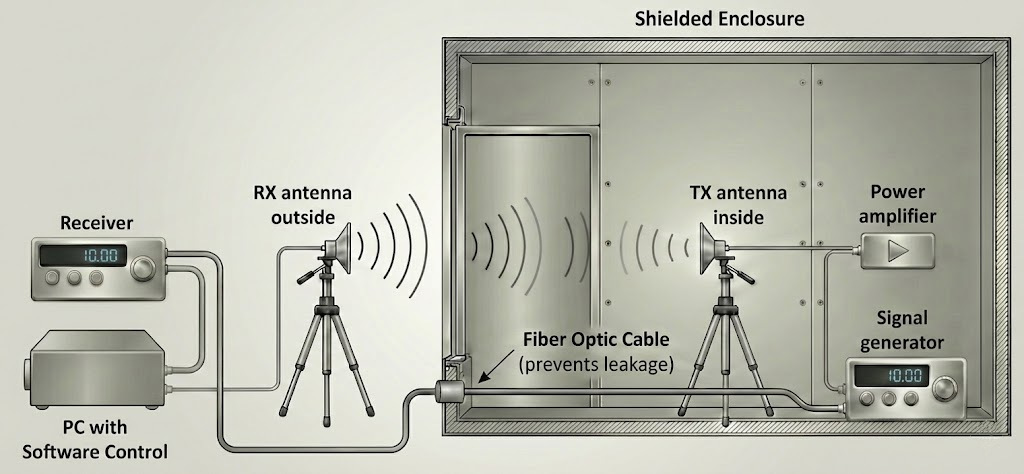
MIL-STD-285 outlines a specific set of guidelines for transmitter and receiver placement to calculate Shielding Effectiveness (SE).
The Test Setup
The process involves an “Inside/Outside” approach:
- Transmitter & Receiver: A transmitting antenna is placed on one side of the enclosure (often outside), and a receiving antenna is positioned on the opposite side.
- Reference Level: A baseline measurement is taken with no shield present.
- Attenuation Measurement: The measurement is repeated with the enclosure’s barrier in place. The difference in signal strength is recorded as the Shielding Effectiveness (SE) in decibels (dB).
Measurement Points
- Frequency Sweep: We test multiple frequencies, ranging from low RF (100 kHz) up to microwave frequencies (10 GHz).
- Locations: We probe multiple surface locations—specifically targeting potential weak points like doors, corners, and cable penetrations—to ensure comprehensive coverage.
Who Uses MIL-STD-285 Testing?
- Defense & Military Contractors: Companies designing shielded command centers, bunkers, or vehicle-based compartments.
- Government Labs: Facilities verifying older or existing structures that still reference MIL-STD-285 in their policy documents.
- Electronics Manufacturers: Suppliers needing to meet legacy contractual specs or bridge older test reports to new designs.
Our MIL-STD-285 Services
We offer a comprehensive approach that respects the legacy nature of the standard while utilizing modern instrumentation.
1. Enclosure Design & Consultation
- Material Advice: We recommend metals, layered composites, or advanced coatings that meet the required attenuation levels.
- Component Selection: We address critical leak paths by selecting door seals, waveguide vents, and cable feedthroughs that align with MIL-STD-285 procedures.
2. Test Plan Development
- Custom Protocols: We map out frequency points, antenna placements, and calibration routines specific to your project scope.
- Modern Alignment: We align the older guidelines of MIL-STD-285 with modern instrumentation best practices to ensure accuracy.
3. On-Site Testing & Troubleshooting
- Leak Detection: Before final certification, we use partial scans to identify “leak” areas—such as door seams or panel junctions—and suggest immediate modifications like improved gaskets.
- Execution: We travel to your site to perform testing on large enclosures or fixed installations in-situ.
- Reporting: You receive a formal report referencing MIL-STD-285 steps, ensuring full compliance with your contract or policy.
4. Integration with Newer Standards
- If your project references multiple standards, we can harmonize the test approach to cover MIL-STD-285 alongside newer requirements like IEEE 299, MIL-STD-188-125-1 or MIL-STD-188-125-2, saving you time and cost.
Frequently Asked Questions (FAQ)
Technically, yes. IEEE 299 is the more modern iteration. However, MIL-STD-285 is still widely recognized and enforced in older contracts or legacy programs. If your contract says “MIL-STD-285,” you must test to that specific standard.
Historically, it is used up to around 10 GHz. For higher frequencies, we typically recommend adapting the procedure or referencing IEEE 299 expansions, though we can adapt our instrumentation to extend coverage if strictly required.
Not necessarily. Most MIL-STD-285 tests are performed in-situ with portable transmitters and receivers placed around the enclosure. The key to accuracy is consistent calibration and correct reference measurements.
We don’t just walk away. Our troubleshooting phase helps pinpoint the specific leakage point—often a poor door gasket or cable shield—and we recheck the solution until you meet the required attenuation.
Ready to Verify Your Enclosure for Compliance?
Don’t let an outdated or insufficient shielding report compromise your defense project.
Contact Castle Compliance today to learn how our MIL-STD-285 testing and consulting expertise ensures robust RF attenuation that meets both crucial EMI/EMC requirements and legacy specifications.