
IP Code Acceptance Criteria
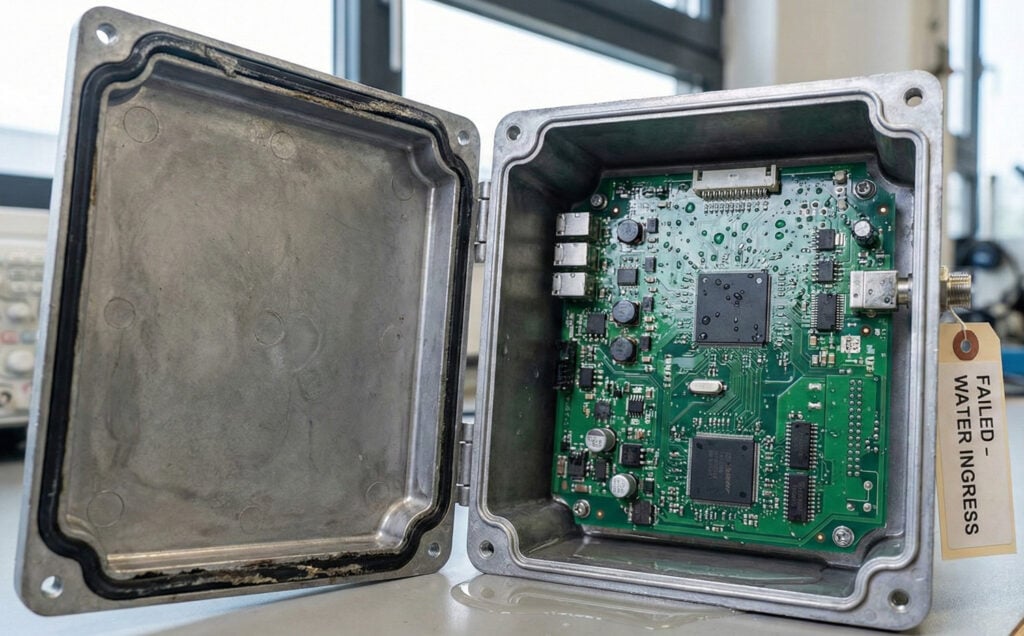
What Passing an IP Test Actually Means
One of the most common misconceptions about Ingress Protection (IP) testing is that a “pass” means the enclosure remains perfectly dry or pristine inside. While this is true for some high-level ratings, the reality for most IP codes is more nuanced.
At Castle Compliance, we don’t just run the water jets and dust fans; we evaluate the results against strict Acceptance Criteria. Understanding these criteria is essential for manufacturers, as it determines whether a little bit of water inside your unit is a test failure—or a perfectly acceptable pass.
The Role of Product Standards
It is important to note that IEC 60529 is a “basic safety standard.” This means it provides the testing methodology and baseline codes, but specific product standards often take precedence.
For example, a lighting fixture (IEC 60598) may have different allowable water ingress limits compared to a consumer electronic device. When a dedicated product standard doesn’t exist, or doesn’t specify its own criteria, the acceptance conditions default to those found in IEC 60529.
Acceptance Criteria for Solid Foreign Objects (First Numeral)
The acceptance criteria for solids depend heavily on whether you are testing for large objects (IP1X–IP4X) or dust (IP5X–IP6X).
IP1X through IP4X: Hands, Tools, and Wires
For the lower numerals, the criteria are binary and physical. We use calibrated access probes—spheres, jointed fingers, rods, and wires—applied with a specific force.
- The Acceptance Rule: The protection is satisfactory if the full diameter of the specified probe does not pass through any opening.
- Hazardous Parts: Even if a probe partially enters, it must not have “adequate clearance” from hazardous live parts or hazardous mechanical parts.
IP5X: Dust-Protected
IP5X is unique because it allows for some ingress. The goal of this rating is not to seal the unit hermetically, but to prevent dust from entering in harmful quantities.
- The Acceptance Rule: Talcum powder may enter the enclosure, but protection is satisfactory only if the dust does not accumulate in a quantity or location that would:
- Interfere with the correct operation of the equipment.
- Impair safety.
- Lead to tracking along creepage distances (electrical insulation paths).
IP6X: Dust-Tight
This is the highest level of solid particle protection and is far stricter than IP5X.
- The Acceptance Rule: At the end of the test, there must be no observable deposit of dust inside the enclosure. Even a faint trace of the testing powder constitutes a failure.
Acceptance Criteria for Water (Second Numeral)
Water testing (IPX1 through IPX9) introduces the most variable acceptance criteria. Unless you are testing for a “hermetically sealed” rating, some water ingress is often permissible, provided it is managed correctly.
According to IEC 60529 Clause 14.3, if any water enters the enclosure, it must generally meet the following four conditions to pass:
- No Operational Interference: The water must not interfere with the correct operation of the equipment or impair safety.
- No Tracking: Water must not deposit on insulation parts where it could lead to tracking along creepage distances.
- No Contact with Live Parts: Water must not reach live parts or windings that are not designed to operate when wet.
- No Cable Accumulation: Water must not accumulate near the cable end or enter the cable itself.
The Importance of Drain Holes
If your enclosure is designed with drain holes, we verify that any entering water drains away effectively without harming the equipment. If water enters but drains out as intended, the unit typically passes. For enclosures without drain holes, we must ensure that any accumulation does not rise to the level of live parts.
Testing for Hazardous Parts (Additional Letters)
Occasionally, an IP code will include an additional letter (A, B, C, or D). This testing focuses solely on the safety of personnel accessing the enclosure.
- The Acceptance Rule: The access probe (such as a test finger or wire) must maintain adequate clearance from hazardous parts.
- For low-voltage equipment, the probe must not touch live parts.
- For high-voltage equipment, the enclosure must withstand a dielectric strength test when the probe is in the most unfavorable position.
Why “Pass/Fail” Requires Expertise
Defining acceptance criteria is rarely black and white. It requires a deep understanding of both the testing standard and the internal components of your product. A few drops of water on a plastic housing might be a pass, while the same drops on a printed circuit board could be a hard failure.
At Castle Compliance, we help manufacturers navigate these nuances. We don’t just report ingress; we analyze the impact to ensure your product is compliant and safe for its intended market.
Ready to certify your product?
Contact Castle Compliance today to schedule your Ingress Protection testing or to discuss the specific acceptance criteria for your device.