
IP5X & IP6X Dust Ingress Testing
Third-party testing for Dust Protected and Dust Tight enclosures. Expert guidance on Category 1 vs. Category 2 classification.
It’s Not Just Dust. It’s Physics.
Dust is relentless. It works its way into microscopic gaps that water often bridges over. For industrial machinery, outdoor telecom equipment, and consumer electronics, dust ingress can cause overheating, short circuits, and mechanical jamming.
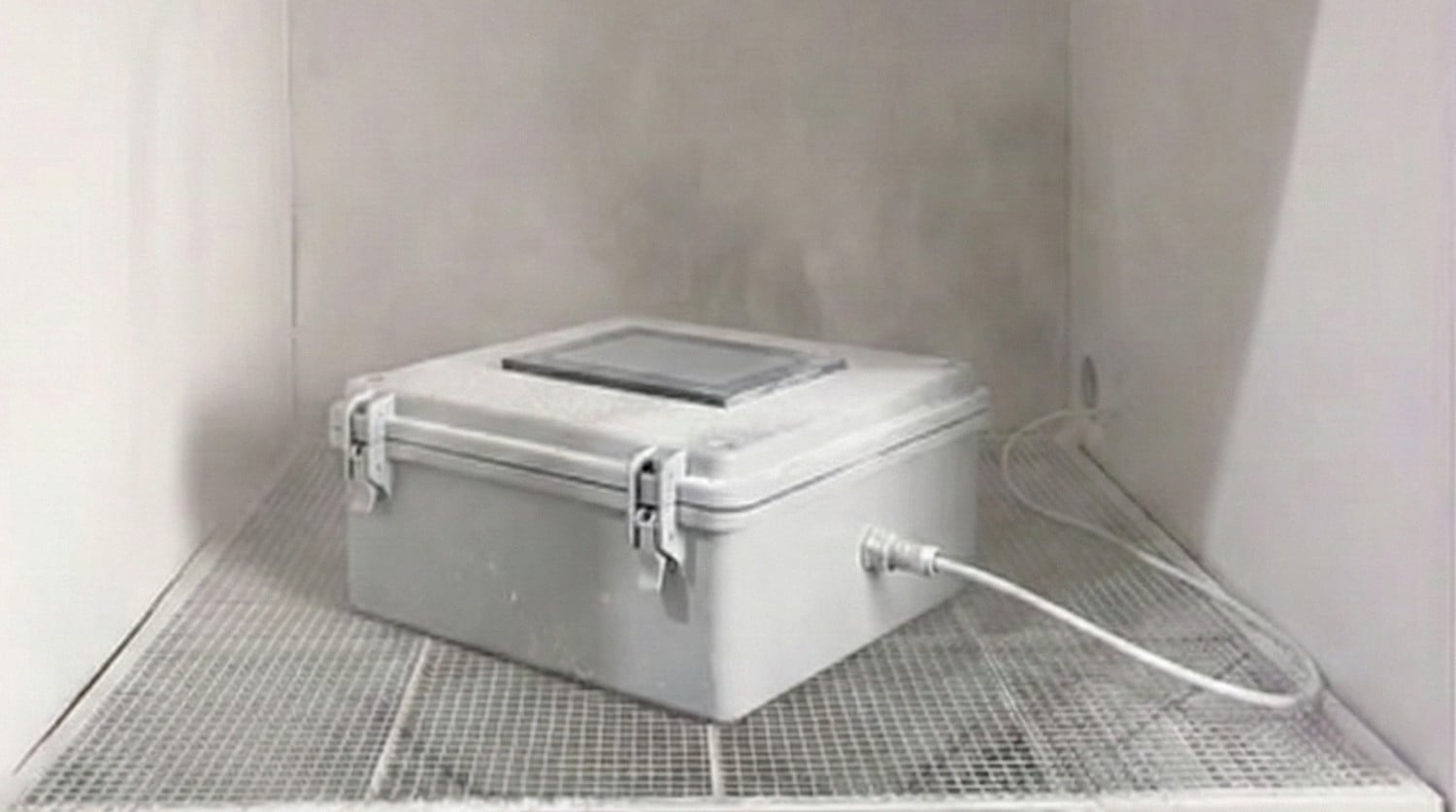
At Castle Compliance, we operate large-scale dust chambers capable of testing to IP5X (Dust Protected) and IP6X (Dust Tight) standards. Unlike labs that cut corners or apply “one-size-fits-all” logic, we follow the specific protocols mandated by IEC 60529 while applying sound engineering judgment to your specific product application.
How a Dust Test is Performed
While the specific pass/fail criteria change based on the rating, the physics of the test setup remain consistent. Here is the lifecycle of a dust test in our lab:
1. The Chamber & Suspension: The product is placed in a sealed test chamber. The bottom is filled with the specific test medium (2kg of powder per cubic meter). A circulation pump runs to keep the dust in suspension, creating a cloud that surrounds your product from all sides.
2. The Vacuum (Simulating Real-World Pressure): For Category 1 tests, we connect a vacuum line to your product’s cable port or a dedicated test hole.
- The Target: We aim to draw air from the enclosure at a rate of 40 to 60 volumes per hour.
- The Limit: We continually monitor the pressure differential. The depression is never allowed to exceed 20 mbar (2 kPa) to prevent artificially destroying seals that would otherwise pass.
3. The Duration: The test stops once 80 times the volume of the enclosure has been drawn through.
- Fast Scenario: If we achieve the target flow rate, the test typically lasts 2 hours.
- Slow Scenario: If the seals are tight and we hit the 20 mbar limit with low flow, the test continues until 80 volumes are drawn or 8 hours have elapsed.
4. Post-Test Inspection: Once the cycle is complete, we remove the unit, clean the exterior, and open it for inspection. We check for dust deposits inside the housing and, if required, perform a functional check to ensure the device still operates safely.
Test Preparation: The Vacuum Connection
For Category 1 tests, we need to physically connect a vacuum hose to your enclosure. Here is how we handle it:
The Standard Connection (Barbed Fitting)
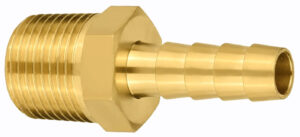
The most reliable method is to install a standard barbed fitting with NPT threads directly into the housing wall.
- We Can Install It: If you authorize us, our shop can drill, tap, and install the fitting for you.
- You Can Install It: You can ship the unit with the fitting pre-installed.
It is best practice to send two separate units (one for dust, one for water). However, we can accommodate testing with one unit if you have limitations on supplying multiple units. In this scenario, we prefer to run the water test first then modify the unit for the dust test afterwards. A plug can be installed in lieu of a barbed fitting if you will be installing it before sending the unit. It usually does not lead to water ingress as long as teflon tape is used on the threads and the tapped hole is machined precisely. But ideally we mitigate the risk by controlling the order of tests or using a separate unit.
Solutions for “Impossible” Connections
Have a thin-walled consumer device, a tiny cable splice, or a sealed connector where drilling a 1/8″ NPT hole is impossible?
Don’t panic! Our engineers have developed techniques for connecting vacuum lines to non-standard geometries without destroying seal integrity. Contact us to discuss your specific constraints.
The Critical Distinction: Category 1 vs. Category 2
The standard separates enclosures into two categories based on whether the testing requires a vacuum to simulate the “breathing” effect of thermal cycling.
Category 1 (The “Vacuum” Test)
- Definition: Enclosures where normal operation generates heat (e.g., motors, lights, electronics), causing internal air to expand and contract.
- Requirement: We must pull a vacuum to simulate this cooling cycle.
Category 2 (The “Passive” Test)
- Definition: Enclosures that do not generate heat (e.g., passive junction boxes, terminal blocks).
- Requirement: The unit sits in the chamber for 8 hours without a vacuum connection. This tests natural settling only.
Our Consultative Approach to IP5X
The Standard’s Rule: IEC 60529 states that for IP5X, the enclosure “shall be deemed Category 1” unless the relevant product standard specifically specifies Category 2.
The Castle Compliance Difference: Many labs blindly default to Category 1 (over-testing) or lazily default to Category 2 (under-testing). We take a technical approach:
- Product Standard Check: If you have a product standard that allows Category 2, we follow it.
- Technical Justification: If no specific product standard exists and your product is purely passive, applying a vacuum may be unwarranted.
- The Solution: Our experts work with you to determine if your device meets the technical definition of Category 2. If justified, we document this rationale in the test report, ensuring you get a fair test that stands up to scrutiny without being draconian.
Note: For IP6X (Dust Tight), the standard allows no leeway. All IP6X tests must be performed as Category 1 (Vacuum).
Common Lab Mistakes (Don’t Let Them Fail You)
Mistake #1: The “Vacuum/Time Trap” Some labs simply set the vacuum to the maximum (20 mbar) and run it for the full 8 hours, regardless of the product size.
- Why it’s wrong: IEC 60529 states the test should stop once 80 volumes have been drawn through.
- Our Method: We calculate your enclosure volume before the test. If we reach the 80-volume target in 2 hours, we stop. We don’t stress your seals for an extra 6 hours unnecessarily.
Mistake #2: The “Blanket Category 2” Somes labs mistakenly run all IP5X tests as Category 2.
- The Risk: If your product generates heat (e.g., an LED driver, a computer, etc.), a regulator may reject a Category 2 test report as invalid. We ensure your test category matches your hardware reality.
Our Dust Capabilities
- Standard Medium: Talcum Powder (per IEC 60529).
- Particle Size: Extremely fine wire mesh spacing (50μm wire, 75μm gap). This lubricious powder finds the smallest leak paths.
- Automotive Medium: Arizona Road Dust (per ISO 20653).
- Particle Size: Abrasive mix (A2 Fine). Used for automotive components to test for mechanical abrasion and clogging.
- Chamber Size: Capable of housing everything from small wearables to large industrial control panels. Our team has experience engineering solutions to test extremely large enclosures as well (e.g., EV battery packs and charging systems, floor standing electronics cabinets, shipping containers, and beyond).
Ready to Verify Your Seals?
Don’t let dust compromise your product’s reliability. Contact our engineering team to schedule your IP5X or IP6X test.