
IP69K & IPX9 High-Pressure Washdown Testing
Validating enclosure survival against steam cleaning, sanitization, and high-pressure sprays.
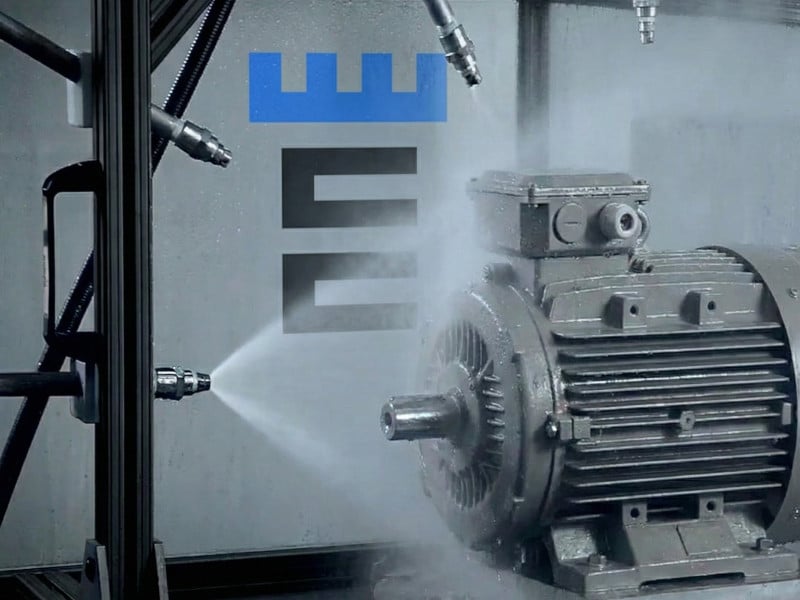
The Ultimate Test of Sealing Durability
If your product is mounted on a cement mixer, a food processing line, or the bumper of a truck, it won’t just face rain—it will face the pressure washer.
IP69K (ISO 20653) and IPX9 (IEC 60529) are the highest ratings in the ingress protection hierarchy. They simulate the rigorous cleaning processes used in heavy industry, where jets of near-boiling water are blasted at the device from close range to remove grease, grime, and bacteria.
At Castle Compliance, our ISO 17025 compliant laboratory features specialized high-temperature pumping systems capable of generating the 1450 psi and 80°C conditions required to certify your product for the harshest environments.
IP69 vs. IP69K vs. IP6K9K: What’s the Difference?
This is the most common question we receive. The tests are nearly identical physically, but the naming convention depends on the standard you are following. The first numeral (6 or 6K) describes the level of protection against solid foreign objects and access to hazardous parts. In this case, IP6X / IP6KX means the enclosure is dust-tight. The second numeral (9 or 9K) describes the level of protection against liquids (i.e., water). In this case, IPX9 / IPX9K means the enclosure offers protection against high-temperature, high-pressure steam jet cleaning like pressure washing. Often, these ratings go hand-in-hand, as they are the most stringent level of protection for enclosures. The legacy rating is “IP69K”.
| Designation | Standard | Primary Industry | The Nuance |
| IP69 | IEC 60529 | Industrial / Consumer | IPX9 added in Amendment 2 of the standard (circa 2013). IEC 60529 does not use the “K” suffix. |
| IP6K9K | ISO 20653 | Automotive | The suffix “K” denotes specific automotive requirements. Absorbed content of DIN 40050-9. First published in 2006. Uses the term “Steam Jet Cleaning”. |
| IP6K9K | DIN 40050-9 | Legacy Automotive | The German standard that originated the “IP6K9K” rating (circa 1993). The standard was withdrawn in 2012 and mostly replaced by ISO 20653. |
| IP69K | N/A | Industrial / Consumer | The rating often cited for protection against dust and pressure washing. |
The Castle Advantage: We help manufacturers determine which test standards and methodologies are appropriate for their situation. Contact us today to discuss your requirements.
Visit this page for in-depth history of IP69K nomenclature, differences between the standards, and industry analysis.
The Test Parameters (It’s Not Just Pressure)
The difficulty of this test comes from the combination of heat, pressure, and distance.
- Water Temperature: 80°C ± 5°C (176°F). This heat softens gaskets and plastics, making them more vulnerable to deformation.
- Water Pressure: 80 to 100 bar (1160 to 1450 psi).
- Flow Rate: 14 to 16 Liters per minute.
- Distance: The nozzle is held just 100mm to 150mm (4 to 6 inches) from the product.
- The Angles: The product is sprayed from 0°, 30°, 60°, and 90° angles while rotating at 5 rpm.
Why Products Fail IP69K
Passing a submersion test (IP67) does not guarantee you will pass IP69K. The failure modes are completely different.
1. Thermal Shock: When 80°C water hits a room-temperature enclosure, the plastic expands rapidly. If the gasket material doesn’t expand at the same rate, a gap opens up. Conversely, if the unit is hot and sprayed with cooler water, the vacuum effect sucks the high-pressure spray directly inside.
2. Physical Destruction: The impact force of the jet is high enough to peel off safety labels, blast open snap-fit latches, and strip silicone sealant right off the seam.
- Castle Tip: Mechanical fasteners (screws) are generally preferred over snap-fits for IP69K applications.
3. Vent Penetration: Standard “waterproof” breathable membranes (vents) will often rupture under 1450 psi. You must use vents specifically rated for high-pressure washdown or protect them with a deflection cowl.
Large vs. Small Enclosures
The test method changes slightly based on the size of your product.
- Small Enclosures (<250mm): The unit is placed on a turntable rotating at 5 rpm. We spray for 30 seconds at each of the 4 angles (0∘,30∘,60∘,90∘).
- Large Enclosures (≥250mm): The unit is tested manually. We spray the entire surface area from a distance of 175mm, ensuring every square meter is wetted for at least 1 minute.
Ready for the Pressure Test?
Whether you are building sensors for dump trucks or control panels for a dairy plant, Castle Compliance has the equipment to validate your IP69K claims.