
IPX7 & IPX8 Immersion Testing
Validating product integrity against temporary and continuous submersion.
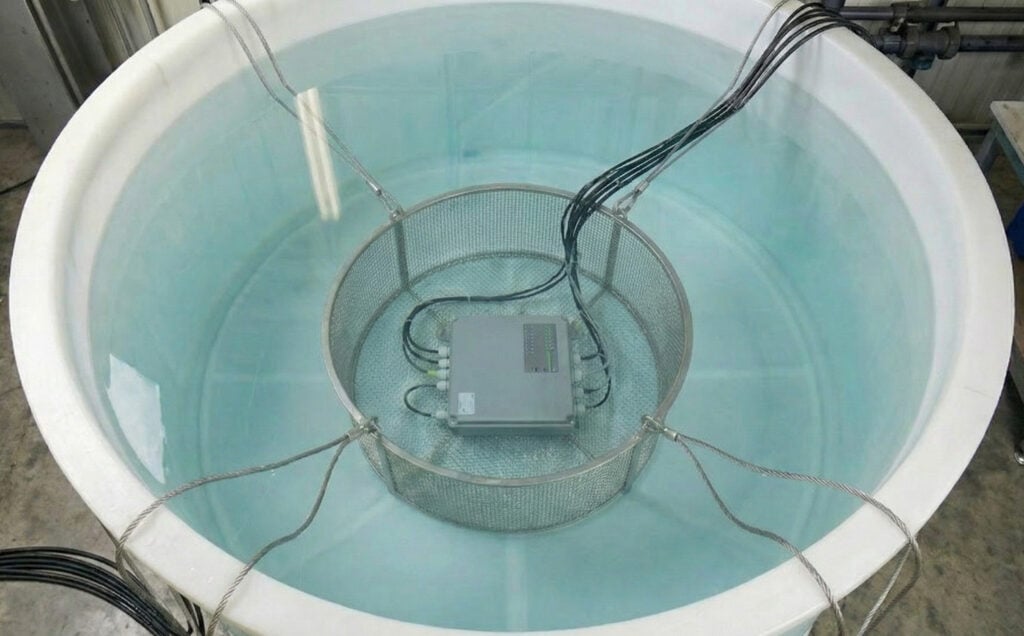
True “Waterproof” Verification
For consumer electronics, wearables, and industrial sensors, “Splash Proof” isn’t enough. Your customers expect your product to survive a drop in the pool, a flooded manhole, or continuous underwater operation.
IPX7 and IPX8 are the definitive ratings for immersion protection under IEC 60529.
- IPX7: Temporary submersion (accidental drops).
- IPX8: Continuous submersion (underwater equipment).
At Castle Compliance, we utilize calibrated immersion vessels and precise temperature controls to ensure the test conditions adhere strictly to the standard, providing you with defensible data for your global product launch.
The Difference: IPX7 vs. IPX8
While both tests involve putting the product underwater, the strictness of the parameters differs significantly.
IPX7: Temporary Immersion
This is the industry standard for “waterproof” consumer devices (smartphones, watches). The standard defines specific depth requirements based on the height of your product:
- Small Enclosures (< 850 mm tall): The lowest point of the enclosure must be located 1000 mm (1 m) below the surface of the water.
- Large Enclosures (≥ 850 mm tall): The highest point of the enclosure must be located 150 mm below the surface of the water.
- Duration: 30 minutes.
IPX8: Continuous Immersion
This is a more severe rating for products intended to stay underwater or survive deeper pressures.
- The Depth: Agreed upon by manufacturer and user. However, it must be more severe than IPX7.
- The Duration: Agreed upon by manufacturer and user (taking into account continuous immersion in actual use).
The Goal: To prove long-term reliability under pressure and resistance to slow permeation.
Castle Tip: How to Select Your IPX8 Specs
We often see manufacturers choose “1.1 meters” for IPX8 just to beat the IPX7 standard by a few inches for marketing purposes. We advise against this.
An IP rating should reflect your product’s end-use reality, not just a marketing number. When defining your IPX8 test plan, consider:
- The Environment:
- Swimming Pool Products: Pools are typically 2 to 3 meters deep. A 1.1-meter rating may be insufficient.
- Sump Pumps: May need 5 to 10 meters of head pressure.
- Marine Gear: May require significant depth ratings.
- Contractual Requirements: Does your customer (e.g., a municipality or military buyer) have a specific depth requirement in their purchase spec?
- The “Continuous” Factor: IPX8 implies “continuous immersion”. Testing for 30 minutes at 1.1m (just barely over IPX7) does not prove the device can survive a week underwater. We help you select a duration (e.g., 24 hours, 7 days) that proves seal longevity.
Visit our IP68 testing page to learn more about depth and duration selection.
Most Common IP Code Immersion Ratings
Ingress Protection (IP Code) ratings most commonly include a designation for both the level of protection of against solid foreign objects (first numeral) and level of protection against water (second numeral). When the level of protection against water is specified as IPX7 or IPX8 immersion, the most complimentary ratings for protection against solid foreign objects is IP6X. The complete ratings are IP67 and IP68.
The “Thermal Shock” Variable
A common mistake in generic testing is ignoring water temperature. IEC 60529 states that the water temperature should not differ from the product temperature by more than 5 Kelvin (5°C).
Why it Matters: If a hot product (e.g., a running motor) is dunked into cold water, the air inside the housing contracts rapidly. This creates a vacuum that actively sucks water past the seals.
Our Process: We monitor the temperature delta. If your product requires a “live” test while heating up, we can modify the test to manage pressures or simulate the worst-case thermal shock scenario if required by your specific product standard.
The “Cumulative” Myth: IPX7 vs. IPX6
It is a widespread misconception that an IPX7 (Immersion) rating automatically covers IPX6 (Powerful Jets). This is false.
According to the standard, an enclosure rated for immersion (IPX7 or IPX8) is not automatically suitable for exposure to water jets (IPX5 or IPX6) unless it is dual-coded.
- The Physics: Immersion applies uniform static pressure. Jets apply directional dynamic pressure (impact force). A seal might hold underwater but deflect and leak when blasted by a hose.
- The Solution: If your product needs to survive both rain/cleaning AND submersion, we execute a Dual-Certification Test Plan (e.g., IP66/IP67).
Common Failure Modes
1. Cable Ingress Water often travels inside the jacket of a cable (wicking) and enters the enclosure from the inside out. We test with your actual cabling to catch this “backdoor” leak.
2. Long-Term Permeation (IPX8) For continuous immersion, gaskets can eventually saturate or “relax” (compression set), leading to slow leaks that wouldn’t show up in a short test.
3. Buoyancy Issues If your product floats, it isn’t being tested at the proper depth pressure. We design custom fixtures to hold buoyant products at the required test depth without stressing the housing or interfering with the seals.
Deep Dive: Acceptance Criteria
Does a single drop of water mean failure? Not always. IEC 60529 allows for some ingress provided it does not:
- Interfere with correct operation.
- Reach live parts.
- Accumulate near cable ends .
We work with you before the test to define your acceptance criteria—whether that means “Zero Ingress” for high-voltage electronics or “Managed Ingress” for drainage-equipped housings.
Prove Your Product Can Take the Plunge
Secure your “Waterproof” claim with accredited, engineering-grade testing. Contact us to discuss your IPX7 immersion testing depth and duration requirements.