
IEC 60598-1 Ingress Protection Testing for Luminaires
Specialized Ingress Protection Testing for LED fixtures, luminaires, streetlights, and architectural lighting.
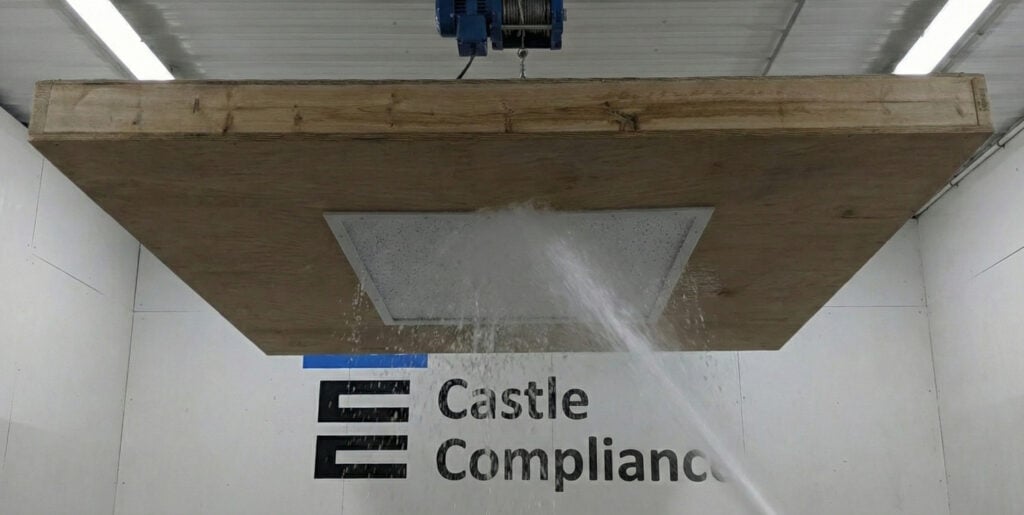
IEC 60598-1 is an international standard titled “Luminaires – Part 1: General requirements and tests,” published by the International Electrotechnical Commission (IEC). While it serves as the foundational safety document for the lighting industry, it places a heavy emphasis on ingress protection (IP) testing to ensure luminaires can safely operate in their intended environments. The standard specifies detailed testing protocols—referencing and often refining the methods found in IEC 60529 — to verify that a luminaire’s enclosure effectively prevents the entry of dust and water. Because lighting fixtures are subject to internal heat cycles that can create vacuums and draw in moisture, IEC 60598-1 mandates that luminaires be brought to a stable operating temperature immediately before testing for the ingress of dust and water. This thermal conditioning simulates real-world operating conditions, specifically the pressure differentials (or ‘breathing’ effect) caused by thermal expansion and contraction, which can draw contaminants into the enclosure
Contact us today to learn more about our Ingress Protection Testing and certification services.
More Than Just “Waterproof”
For lighting manufacturers, ingress protection is not just about keeping water out — it is about ensuring electrical safety and longevity in thermally dynamic environments. IEC 60598-1 is the general requirement standard for luminaires, incorporating strict protocols for resistance to dust, solid objects, and moisture (Section 9).
At Castle Compliance, we understand that a luminaire faces different challenges than a generic junction box. It cycles from hot to cold every day, creating internal pressure changes that stress gaskets. Our ISO 17025 compliant laboratory specializes in testing lighting enclosures under these realistic, standard-defined conditions.
Section 9: Resistance to Dust, Solids, and Moisture
While IEC 60598-1 references the generic IEC 60529 (IP Code) methods, it applies them with specific conditions relevant to lighting. We test the full range of IP ratings required for modern lighting products.
Common Lighting IP Ratings We Test
- IP20 (Indoor Residential): Protection against fingers (12.5mm probe) but no protection against water. Common for recessed lights and track lighting.
- IP44 (Bathrooms/Vanity): Protection against tools/wires (>1mm) and splashing water.
- IP65 (General Outdoor): Dust-tight and protected against low-pressure water jets. Standard for parking lot fixtures and wall packs.
- IP66 (Heavy Duty Outdoor): Dust-tight and protected against powerful hose-down jets. Required for marine lighting or areas subject to heavy storms.
- IP67 (Landscape/In-Ground): Temporary immersion. Critical for in-ground “well lights” that may sit in puddles.
- IP69 (Food Processing/Medical Operating Room): Dust-tight and protected against high-temperature/high-pressure washing.
The “Thermal Difference”: Why Generic IP Testing Isn’t Enough
The Thermal Vacuum Effect: When a light fixture is turned on it heats up and the air inside expands. When it is hit by cold rain (or test water), the air contracts, creating a vacuum that actively sucks moisture through the seals. If you send your luminaire to a generic test lab, they might just spray it with water at room temperature. This may be invalid under IEC 60598-1. The standard requires specific thermal conditioning before or during the test to simulate real-world failure modes.
Ingress Protection Testing at Castle Compliance is performed by engineers that follow the testing standards in detail, including the thermal preconditioning requirements prescribed in IEC 60598-1. This ensures your product is tested in a state that mimics this thermal cycling rather than a static “cold” test that might yield a false pass.
Lighting-Specific Failure Analysis
We help lighting engineers solve the most common causes of IP failure in luminaires.
- Lens/Housing Expansion: Different thermal expansion rates between a glass lens and an aluminum housing can cause gaps to open up during thermal cycling.
- Cable Gland Leaks: Water often enters not through the housing, but through the power feed. We verify that your cable glands match the IP rating of the fixture.
- Condensation vs. Ingress: Sometimes, water inside the lens isn’t a leak—it’s condensation. Our degreed engineers help you distinguish between a seal failure and a dew-point issue.
Frequently Asked Questions (FAQs)
Our primary focus is Section 9 (Resistance to Dust, Solid Objects, and Moisture) and related environmental sections. We provide the environmental data you need to complete your larger safety certification file. If you require full electrical safety testing (dielectric strength, leakage current), please let us know so we can discuss the full scope.
Yes. Our facility is equipped with open-area spray zones capable of accommodating street heads, high-bay fixtures, and stadium floodlights.
Yes. To perform a valid thermal test, the unit should ideally be powered to reach its operating temperature. Please provide the driver and mating connectors so we can power the unit during or prior to the spray test as required.
IEC 60598-1 requires that luminaires be mounted and wired as in normal use and placed in the most unfavorable position, complete with translucent covers, if any. Our engineers consult with you to determine the possible orientations of your lighting product in-service and the most unfavorable test orientation.
If the installation instructions indicate that a luminaire is for ceiling or under-canopy mounting, the luminaire is attached to the underside of a flat board or plate which extends 10mm beyond the part of the luminaire perimeter in contact with the mounting plate. Castle Compliance can handle the fabrication of test fixtures and install the luminaires per the manufacturer’s instructions.
The luminaires are powered on and brought to a stable operating temperature at the rated voltage. Thermocouples and infrared thermometers are used to determine when temperature stability has been reached.
Validate Your Design Before Tooling
Don’t wait until mass production to find out your gasket design fails under heat. Contact our engineering team for specialized luminaire testing.